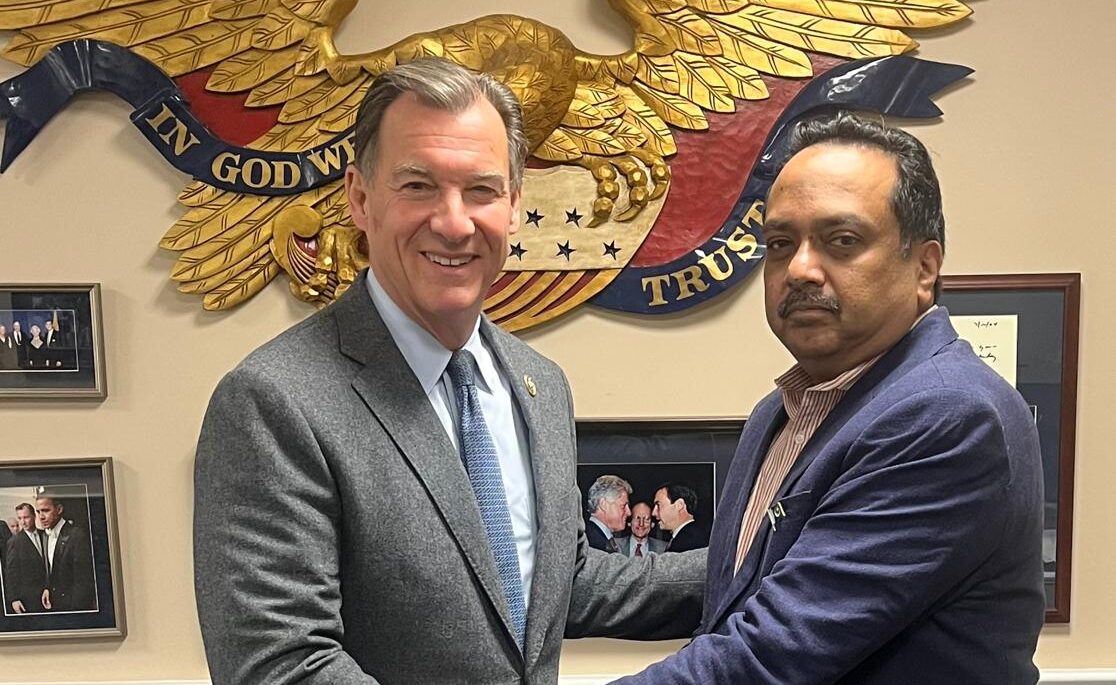
NewYork : Chair of the Pakistan Caucus in the United States Congress Congressman Suozzi said in a meeting with renowned Foreign affairs expert Muhammad mehdi in NewYork that the challenges Pakistan faces being one of the largest victims of terrorism in the world, and what we have to do to secure the safety of the Pakistanis. People fail to realize that Pakistan is really the victim of terrorism more than any other place in the world, even more than Burkina Faso.
Pakistan is facing this tremendous level of terrorism and we have to do whatever we can to try and help our friends in Pakistan. Pakistan has a significant challenge. We have a hard enough time securing our border here in the United States of America, and it’s a pretty straightforward flat border along a straight line. Pakistan has to secure a border in a very mountainous, uninhabited region with a very difficult terrain and a lot of outside influences conducting terrorist operations in Pakistan. So, we should do what we can to try and share intelligence with Pakistan. We should try and persuade some of our allies, including India, that it does make sense for us to help sell weapons to Pakistan for the purpose of defending themselves against terrorism.
He insisted that Pakistan has a tremendous role in the future of South Asia, the Middle East, and the entire region. As Pakistan becomes more and more of a trusted partner of the U.S., with deep relationships with everyone throughout the region, including our adversaries, Pakistan can play a very important role as a trusted advisor to help try and reconcile some of the differences between us and our adversaries. Pakistan is playing a very important role right now between the United States and Iran, and we need to recognize the tremendous credibility that Pakistan has in the region.
He highlights that Pakistan has tremendous potential, with an enormous youth population, great natural resources, and incredible talent to improve the relations between our two countries, the United States and Pakistan, with a central focus on building our economic relationships.
He said that, to achieve even better economic relations, Pakistani government should create an independent arbitration board, similar observed in Kazakhstan, so that if two parties—one foreign entity and a local individual—get in a dispute, there’s an independent arbitration board that can decide the issue based upon common law. The arbitrators would be Pakistani attorneys and judges, American attorneys and judges, and even British attorneys and judges. I think this would unlock a tremendous amount of economic investment in Pakistan.
He discussed Pak-India current state of releationship that I traveled to Pakistan on my most recent trip in 2025 , I made a point of traveling to Katarpur Sahib. I was the first member of U.S. Congress to ever visit Katarpur Sahib. I picked that on purpose because I wanted to go to a place that, at the time, was the only place where India and Pakistan had some relations, where people could come across from India into Pakistan to visit the Sikh site.It’s my hope that we can use Katarpur Sahib as a vehicle to lessen the tensions between India and Pakistan.
I understand there’s a long history of enmity between the two countries, but we have to start somewhere. I believe after the conflicts that have taken place over the past two years, we should look to try to reopen that border between India and Pakistan at Katarpur. We should then try to go a next step of some cultural interaction. For example, I think a cricket match would be a great idea, held once in Pakistan and once in India, or here in the United States if it’s necessary.
In tandem with Capitol Hill’s engagement, Muhammad Mehdi underscored that Pakistan continues to follow a balanced geopolitical doctrine. He noted that Islamabad’s strategic trade and diplomatic channels remain capable of bridging divides between global powers, echoing Pakistan’s historical role in facilitating US-China rapprochement.
He further added that enhanced market access for Pakistani goods in the US, combined with structural civilian reforms, remains vital for long-term economic alignment between both nations.