
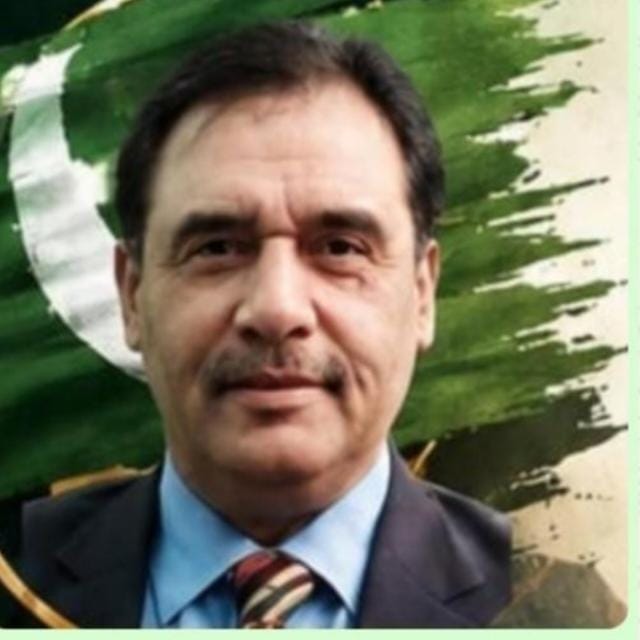

By: Major Waseem Mahmood Butt (Retd.)
President, PESAF
(PAKISTAN Ex-Servicemen of the Armed Forces Veterans, Great PAKISTAN)
This is the land of our martyrs, this homeland of ours;
A garden nurtured with their blood—the garden that is ours.
The unfortunate incident at Sarhad University in Islamabad has compelled every conscientious Pakistani to pause and reflect. This is not merely a dispute, a protest, or an unpleasant confrontation between a few individuals. It raises fundamental questions about our collective conduct, the rule of law, tolerance, dignity, and national unity.
The most important question is:
Does a difference of opinion give us the right to violate one another’s dignity?
Absolutely not.
Students have every right to peacefully protest for their legitimate demands. To question, disagree and raise one’s voice for one’s rights are signs of a living society. But when a protest turns into violence, abuse, humiliation of a woman, surrounding and intimidating a citizen, or placing someone’s life and safety at risk, it ceases to be peaceful protest and becomes a violation of the law.
At the same time, every officer wearing the uniform is equally bound by the law. The military uniform carries honour, but with that honour comes an extraordinary responsibility. An officer is expected to demonstrate restraint, patience and professional discipline even under extreme provocation.
That is why this incident should not be judged through emotions, slogans or a few seconds of social-media footage. It must be determined through a transparent, impartial and comprehensive investigation.
If the officer violated any law or military regulation, he must be held accountable.
Likewise, if members of the crowd resorted to violence, abuse, humiliation of a woman, desecration of the uniform, or endangered the life of any citizen, those responsible must also be brought before the law.
The beauty of the law is that it does not judge the face; it judges the offence.
Yet there is another dimension of this incident that we cannot afford to overlook.
That officer is also someone’s son.
Someone’s brother.
Someone’s husband.
And perhaps the father of innocent children.
The very men who wear that uniform stand today on Pakistan’s frontiers. They serve in the rugged mountains of Balochistan, the challenging terrain of Khyber Pakhtunkhwa, and at the country’s most sensitive frontiers in the fight against terrorism.
They pledge to protect Pakistan’s homes before protecting the comfort and security of their own.
They are the guardians of the honour and dignity of our mothers, sisters and daughters.
So we must ask ourselves:
Is the honour and dignity of the families of those guardians not also our collective responsibility?
This is not an argument for placing a military officer above the law.
It is an appeal to awaken our collective humanity.
God does not change the condition of a people
Until they change what is within themselves.
Allama Iqbal’s timeless message is not meant only for governments; it is a message for nations as well.
We must decide how far we are prepared to take our differences.
Do we want to turn the university student into an enemy of the soldier?
Do we want to turn the soldier into an enemy of the student?
Either way, Pakistan loses.
The Pakistani student is not the enemy.
He is the future of this country.
And the Pakistani soldier is not the enemy either.
He is the one who sacrifices his youth, his peace and, at times, his very life to protect that future.
They are two parts of the same national body.
One represents Pakistan’s future; the other safeguards Pakistan’s present and future.
In whose interest is it to place these two against each other?
We must seriously reflect upon this question.
Pakistan’s enemies do not always fight us only on our borders. In modern warfare, creating psychological distances within nations, eroding public trust in institutions, generating frustration among young people, and setting state institutions against the people are also tools of conflict.
We must not allow anyone to build a wall of hatred between our youth and our Armed Forces.
But this does not mean that any institution, or any individual within it, should be placed beyond criticism.
Accountability does not weaken institutions; accountability strengthens them.
If an officer is at fault, the law must hold him accountable.
If a mob is at fault, the law must hold it accountable as well.
If any political or disruptive element is exploiting the emotions of students and pushing them towards violence or hostility against the state, it too must be exposed.
And if the dignity of any woman has been violated, it is the duty of the state to protect her honour.
For in an Islamic society, the dignity of a woman is not a political, group or institutional issue; it is a matter of our collective honour and moral responsibility.
We must also remember that the true strength of our Armed Forces does not lie merely in guns, tanks or weapons.
Their real strength is the trust of the nation.
And the strength of a nation does not lie merely in numbers.
Its real strength lies in unity.
Therefore, what we need today is not slogans, but wisdom.
Not hatred, but justice.
Not provocation, but restraint.
And above all, Pakistan needs a relationship of trust, respect and affection between its youth and its defenders.
These lamps, if kept alight, will bring forth light;
Otherwise, darkness will prevail throughout the city.
Representing nearly three million ex-servicemen and their families, we wish to make one thing absolutely clear:
We stand with the law.
We stand with justice.
And above all, we stand with Pakistan.
We salute the sacrifices of the martyrs and veterans of the Pakistan Armed Forces, while equally wanting to see a secure, prosperous and dignified future for Pakistan’s youth.
We stand against no innocent person.
We stand in favour of no wrongdoer.
We simply demand that the verdict be delivered by the law—not by noise, emotion or mob pressure.
If we respond to this tragedy with wisdom, this unfortunate incident can become a national lesson rather than another source of division.
Let protests take place at our universities—but with civility.
Let the Armed Forces be criticised—but on the basis of facts.
Let officers be held accountable—but according to law.
And let disagreements with our youth be expressed—but with compassion and respect.
Because, ultimately—
They are all our own.
The soldier standing guard on the frontier.
The student sitting in a university classroom.
And every mother, sister and daughter whose honour and dignity must remain sacred in this country.
Let us not allow anyone to achieve the objective of placing Pakistan’s defenders against Pakistan’s future.
We must not light the fire of hatred; we must light the lamp of trust.
When we stand united, every enemy design is defeated;
When we divide, our own home becomes the victim of the flames.
Long live the youth of Pakistan!
Salute to the martyrs and veterans of Pakistan!
Long live the Pakistan Armed Forces!
Long live our Great Pakistan!
Major Waseem Mahmood Butt (Retd.)
President, PESAF

Leave a Reply