
Six Major Technology Outages in Six Days Raise Cybersecurity Concerns Across the United States
WASHINGTON, November 19, 2026 — A series of major technology disruptions across the United States has raised fresh concerns about the security and...

- According to Reuters, Downdetector recorded approximately 2,300 user reports of Apple Pay problems in the United States at the peak of the disruption, while reports of iCloud problems reached around 1,800.
- For the United States, the challenge is becoming increasingly clear.
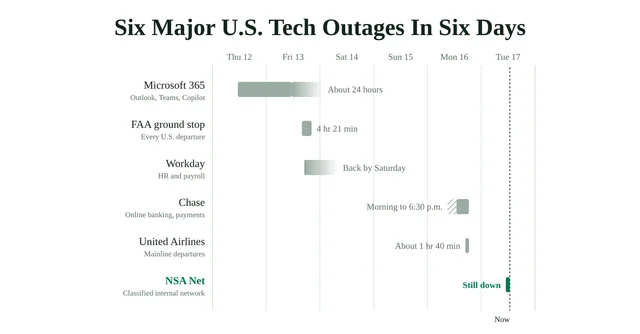
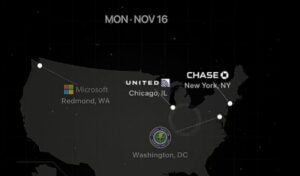
- Within just six days, technical failures affected major services operated by Microsoft, the Federal Aviation Administration (FAA), JPMorgan Chase, United Airlines, the National Security Agency (NSA) and Apple.
WASHINGTON, November 19, 2026 — A series of major technology disruptions across the United States has raised fresh concerns about the security and reliability of the digital systems relied upon by millions of Americans. Within just six days, technical failures affected major services operated by Microsoft, the Federal Aviation Administration (FAA), JPMorgan Chase, United Airlines, the National Security Agency (NSA) and Apple.
The latest incident involved Apple, where an internal software update disrupted several widely used services, including Apple Pay, iCloud, the App Store and platforms used by developers to manage and distribute applications. The disruption came shortly after reports that the NSA’s classified internal communications network had also experienced an outage, adding to growing concerns about the resilience of America’s digital infrastructure.
What makes the sequence particularly striking is the range of organizations affected. The disruptions have reached financial services, commercial aviation, government communications and some of the world’s largest technology platforms. Although each incident has been attributed to a different technical problem, their close timing has prompted questions about whether the country’s increasingly interconnected digital infrastructure is adequately protected against emerging threats.
The first major disruption occurred when Microsoft experienced a widespread outage affecting Microsoft 365 services, including Outlook, Teams and other workplace applications. Businesses and individual users in several countries reported difficulties accessing essential services. Microsoft subsequently attributed the disruption partly to a network-related software defect that emerged during an upgrade.
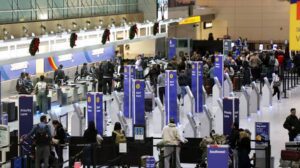
The situation escalated on Friday when a technical failure in the Federal Aviation Administration’s network triggered a nationwide ground stop, bringing air traffic operations across the United States to a temporary halt. The disruption lasted more than four hours, forcing airlines to delay and cancel flights and leaving thousands of passengers facing travel uncertainty. It was one of the most significant nationwide aviation disruptions in recent years.
United Airlines encountered a separate technology failure on Monday, forcing the carrier to delay departing flights while it addressed the problem. The incident added further pressure to an already disrupted aviation system.
The financial sector also experienced difficulties on the same day. JPMorgan Chase reported a technical problem affecting its internal hardware systems, resulting in delays to some banking transactions. The disruption also affected certain transfers involving other financial institutions, highlighting how technical failures at a major bank can have consequences beyond its own customers.
The situation became more concerning when reports emerged that the National Security Agency’s classified communications network, known as NSANet, had gone offline. The network is used to store and share sensitive classified information, making its temporary disruption particularly significant.
U.S. officials indicated that the NSA incident was related to routine maintenance and software security updates rather than a hostile cyber operation. Director of National Intelligence Jay Clayton said that security patches introduced following warnings about vulnerabilities in PHP had caused some systems to fail to restart as expected.
Apple became the latest major technology company to report widespread service problems on Tuesday. Users experienced difficulties accessing iCloud accounts, making payments through Apple Pay and downloading applications from the App Store. Some developer services, including platforms used to submit and manage applications, were also affected.
Apple said the disruption resulted from an internal update and stressed that it was not caused by a cyberattack. The company confirmed that many services had been restored and that efforts were continuing to bring the remaining systems back online.
According to Reuters, Downdetector recorded approximately 2,300 user reports of Apple Pay problems in the United States at the peak of the disruption, while reports of iCloud problems reached around 1,800. These figures represent user-submitted reports rather than the actual number of affected customers.
Despite the different explanations offered by the organizations involved, the timing of the incidents has attracted considerable attention, particularly because of a separate warning issued by the Federal Bureau of Investigation about the growing use of artificial intelligence in cybercrime.
In an advisory dated November 13, the FBI warned that malicious actors were using an AI-powered autonomous penetration-testing framework known as ARTEX to conduct sophisticated cyber intrusions. The tool can automate several stages of an attack, from identifying vulnerabilities and gaining initial access to moving through compromised networks and extracting sensitive information.
The FBI said some attacks involving ARTEX had progressed from initial targeting to privileged access in less than three hours. The framework has reportedly been used against organizations in financial services, government, technology, defence, healthcare, energy and other sectors.
The advisory also described the scale of the threat, identifying attacks against South Korean financial institutions that exposed the personal information of approximately 67,000 individuals. Another campaign involved a supply-chain compromise affecting ConnectWise Cloud Backup customers, potentially exposing more than 2,250 downstream customer environments.
The FBI warned that the tool could allow attackers with relatively limited technical expertise to conduct complex operations at a speed that makes detection and response more difficult for traditional cybersecurity teams.
However, there is currently no official evidence connecting ARTEX to the recent outages involving Microsoft, the FAA, JPMorgan Chase, United Airlines, the NSA or Apple. The FBI advisory identifies a genuine cybersecurity threat, but it does not establish that the tool was responsible for any of these particular service disruptions.
That distinction is important. A series of outages occurring within a short period may raise legitimate security questions, but timing alone cannot establish that the incidents were coordinated or caused by the same actor.
In fact, the explanations provided so far point to different technical problems. Microsoft cited a software defect associated with a network update, the FAA experienced a network failure, JPMorgan Chase reported a software-related issue, Apple blamed an internal update, and the NSA disruption was linked by officials to maintenance and security patching. United Airlines also reported a separate technology problem.
The wider concern, however, goes beyond whether these incidents were connected. Modern economies depend heavily on a relatively small number of technology providers and interconnected digital networks. When one major system fails, the effects can spread quickly to businesses, customers, financial institutions and public services.
Artificial intelligence is adding another layer of complexity. The technology is increasingly being used to identify software vulnerabilities and develop security fixes, but similar capabilities can also help cybercriminals discover weaknesses and exploit them before organizations have time to respond.
Security specialists have warned that this creates a difficult situation for companies responsible for protecting critical systems. Software updates and security patches are essential for preventing cyberattacks, yet poorly tested updates can themselves cause widespread disruption.
The recent incidents have also drawn attention from U.S. lawmakers. Senator Mark Warner, co-chair of the Senate Cybersecurity Caucus, described the disruptions as a wake-up call, warning that the development of artificial intelligence is moving faster than the ability of institutions to manage its consequences.
At the same time, Warner noted that the available evidence suggested the outages could be unintended consequences of efforts to improve system security rather than the result of coordinated malicious activity.
For the United States, the challenge is becoming increasingly clear. Protecting digital infrastructure now requires more than preventing hackers from breaking into networks. It also demands stronger testing procedures, reliable backup systems, effective monitoring and the ability to recover quickly when software updates or automated systems fail.
Six major disruptions in less than a week do not, by themselves, prove that America is facing a coordinated cyberattack. But they do expose how vulnerable essential services can become when so much of modern life depends on interconnected technology.
With the FBI warning that AI-powered tools can help attackers gain privileged access to networks in under three hours, the pressure on technology companies and government agencies to strengthen their defences is growing.
The question facing U.S. authorities is no longer simply whether these outages were caused by hackers. It is whether the country’s digital infrastructure is prepared for a future in which technical failures, software vulnerabilities and increasingly sophisticated cyber threats can have consequences on a national scale.
Senior US based Journalist
Frequently Asked Questions
What is the latest update on united states?
WASHINGTON, November 19, 2026 — A series of major technology disruptions across the United States has raised fresh concerns about the security and reliability of the digital systems relied upon by millions of Americans.
What are the key takeaways and impact?
According to Reuters, Downdetector recorded approximately 2,300 user reports of Apple Pay problems in the United States at the peak of the disruption, while reports of iCloud problems reached around 1,800.

APPAC Urged to Strengthen Political Influence , Leadership Celebrates Historic Electoral Victories in New York

Trump Threatens Ban and Heavy Taxes on US Firms Building AI Data Centres Overseas

Film Director Highlights Authenticity, Forgiveness and Emotional Storytelling in his New Movie Adam’s Fire

Trump, Xi and Putin Hold Historic Summit in Shenzhen, Raising Questions About the Future of Global Power
US Launches ‘Operation Ghostbusters’ to Crack Down on Widespread Federal Student Aid Fraud