
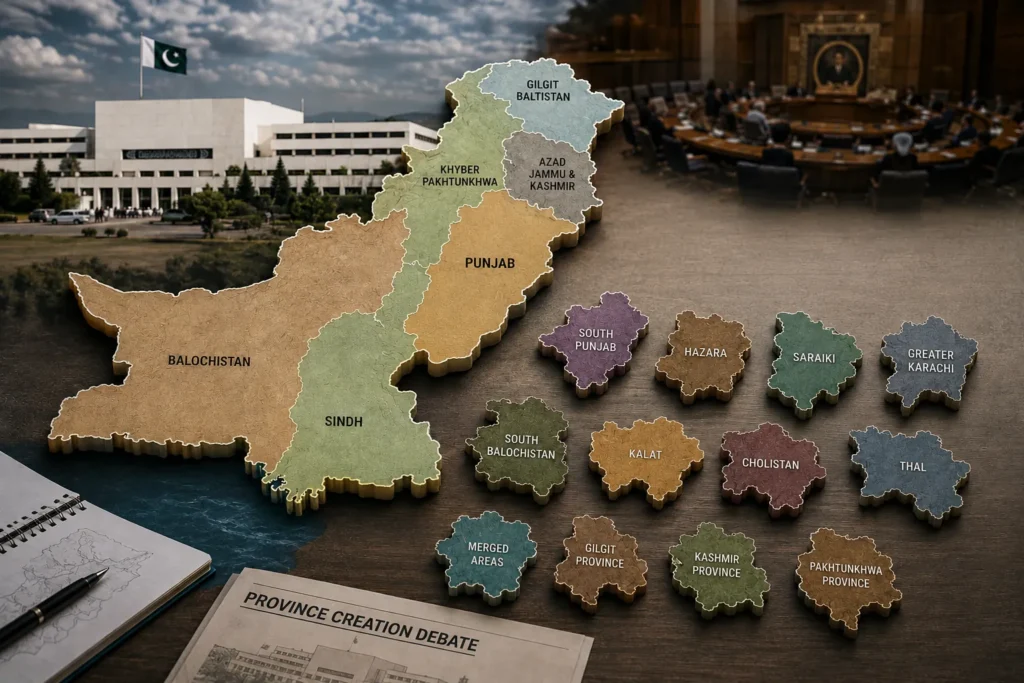

PAKISTAN’s Security, Sovereignty and National Unity must always Stand above political, provincial and institutional differences.* At a time when terrorism continues to challenge the peace and stability of the Country, every debate on Counterterrorism Must begin with One overriding Principle: *whatever policy we adopt Must Strengthen PAKISTAN, Protect its people and reinforce the Unity of the federation*. Against this national backdrop, the recent remarks of Khyber Pakhtunkhwa Chief Minister Sohail Afridi deserve serious consideration—not as another chapter in Centre-province confrontation, but as an opportunity to ask a larger and more important question: how can the federation and its provinces work together to defeat terrorism and preserve the peace, dignity and integrity of PAKISTAN..
At a time when terrorism continues to threaten innocent lives, institutions and national stability, PAKISTAN needs less confrontation and more consultation; less political point-scoring and more collective responsibility.
The KP government’s position is that terrorism in the province is substantially connected with federal policies and that military operations, drone strikes and displacement have often produced unintended consequences. The Chief Minister has therefore called for a greater provincial role in determining counterterrorism policy.
There is nothing undemocratic about questioning an established policy. Indeed, sound policy must remain open to evidence, experience and improvement. The people of KP have endured enormous suffering, and their concerns cannot—and should not—be dismissed.
But there is an equally important principle:
Provincial participation must strengthen national policy, not fragment it.
PAKISTAN is a federation, not a collection of competing security jurisdictions. The Constitution provides distinct responsibilities to the federation and the provinces, but those responsibilities ultimately serve one Sovereign State and One people.
The *federation carries responsibility for National Defence and the employment of the Armed Forces.* Provinces, meanwhile, have indispensable responsibilities for policing, administration, intelligence coordination and civilian governance.
The two levels of government therefore need each other.
Islamabad needs the confidence and cooperation of Peshawar. Peshawar needs the resources, intelligence and national coordination of Islamabad.
Neither can defeat terrorism alone.
This is where the present debate should move from “who is responsible?” to “what can we do together?”
If the KP government believes that the existing counterterrorism strategy requires fundamental change, it should be encouraged to place a comprehensive alternative before the nation. How would terrorist networks be dismantled? How would cross-border infiltration and financing be addressed? What would be the respective roles of police, civil administration, intelligence agencies and the armed forces? And how would the safety and confidence of ordinary citizens be guaranteed?
These are difficult questions—but they are precisely the questions a serious national security policy must answer.
Political slogans, however popular, cannot substitute for strategy.
Nor should disagreement with a federal policy be interpreted as disloyalty to Pakistan. In the same spirit, disagreement with a provincial position should not be allowed to become hostility towards KP or its people.
KP is Pakistan. Balochistan is Pakistan. Sindh is Pakistan. Punjab is Pakistan. Gilgit-Baltistan and Azad Jammu & Kashmir are part of the same national story.
Our diversity is not our weakness. It is one of Pakistan’s greatest strengths—provided that diversity remains united by a common national purpose.
This is why the Centre-province debate must be conducted with maturity and, above all, with mutual respect.
We must never allow political differences to turn into provincial resentment, or provincial identity into national division. Terrorists and Pakistan’s adversaries benefit whenever Pakistanis begin seeing one another primarily through political, ethnic or provincial lenses.
The answer is not uniformity.
The answer is unity with diversity, consultation with coordination, and disagreement without division.
If existing counterterrorism policies need correction, let them be corrected. If new approaches are required, let the best minds of the federation and the provinces develop them together. If military action is unavoidable, let it be undertaken with the greatest possible protection of civilians. If political engagement can prevent violence without compromising the writ of the state, let it be seriously considered.
But whatever course is adopted, there must be one non-negotiable objective:
The security, sovereignty and unity of Pakistan.
Our soldiers, police officers and civilians have all paid a heavy price in the fight against terrorism. Their sacrifices should not become material for political division. They should become a reason for greater national solidarity.
Pakistan today needs a politics of reconciliation rather than perpetual confrontation; a federation built on trust rather than suspicion; and a national conversation in which criticism is welcomed but the country’s unity remains sacred.
The question before us is therefore not whether Islamabad or Peshawar should win.
It is whether PAKISTAN can Win.
And PAKISTAN will win when every province sees the Security of the other as its Own, when every institution performs its constitutional responsibility, and when our political differences remain within the boundaries of National Unity.
Let us disagree as PAKISTANIs, consult as PAKISTANIs, and Stand Together as PAKISTANIs.
Because in the Final analysis; there is No Separate Security of KP and PAKISTAN, No Separate Future of Punjab and PAKISTAN, No Separate Prosperity of Sindh, Balochistan or any other part of the Federation.
There is Only One Great PAKISTAN—and its Strength lies in the LOVE, UNITY and COLLECTIVE Resolve of all its People.
PAKISTAN ARMED FORCEs are the CUSTODIAN Of Great PAKISTAN.
Great PAKISTAN ALWAYS ZINDABAAD.


Leave a Reply