
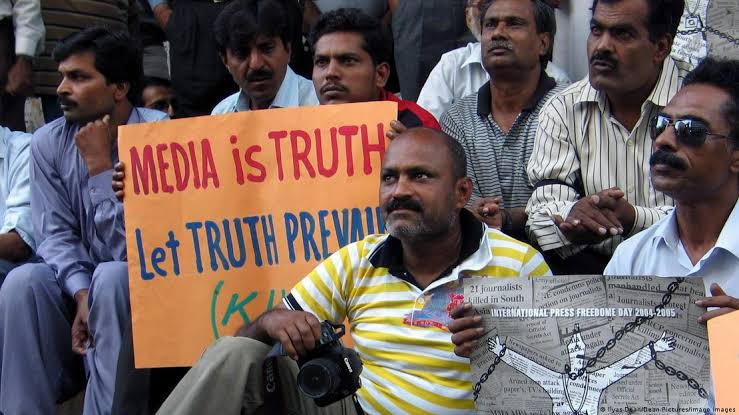

Every year on November 2, the world, including Pakistan, observes the International Day to End Impunity for Crimes Against Journalists. The day serves as a reminder of how journalists around the world are targeted, killed, abducted, and tortured for daring to speak the truth, while those responsible for these crimes often remain beyond the reach of justice. Pakistan, too, is considered one of the most dangerous countries in the world for journalists, who continue to face serious threats while performing their professional duties.
However, as the world marks this important day, Pakistani journalism is confronting an even deeper and more disturbing tragedy. On the one hand, journalists face external threats and the persistent fear that those who attack or murder them will never be brought to justice. On the other, the profession itself is being undermined by an internal crisis of economic hardship and intellectual decline — a crisis I had warned about more than two decades ago.
More than twenty years ago, in March 2004, when electronic media was still establishing itself in Pakistan and the era of digital and social media was nowhere in sight, I published a column in the same newspaper under the title:
As an investigative reporter by profession, I had always focused on uncovering facts, examining issues beneath the surface, and anticipating emerging challenges through careful observation. Furthermore, my four decades of involvement in journalistic politics and active participation in the journalists’ trade union movement have given me extensive insight into the working conditions and professional challenges faced by journalists, both nationally and internationally.
Drawing on this broad national and international experience, I recognized the approaching crisis more than two decades ago. Sadly, neither successive governments nor our own journalistic institutions paid attention to my timely warning and fact-based concerns.
At the time, I did not limit myself to writing columns as an investigative journalist. I also personally alerted the then leadership of the Pakistan Federal Union of Journalists (PFUJ) to the storm that was approaching. I argued that unless we established a strong code of ethics and protective framework to address the emerging digital wave, fake news, and the professional training of reporters, the coming tide would sweep everything away.
Regrettably, the journalists’ organization of that time failed to give this critical issue the attention it deserved.
What followed? The standard of journalism deteriorated, and the profession suffered serious damage. Meanwhile, the historically significant Pakistan Federal Union of Journalists (PFUJ), which had long fought for the rights of working journalists, became engulfed in internal divisions, factionalism, and fragmentation, eventually splitting into numerous groups.
The greatest victims of this organizational breakdown and factional politics have been ordinary, honest journalists and media workers. The very dangers of fake news, misinformation, and sensationalism that I had highlighted twenty-two years ago have now engulfed almost the entire media sector.
News has increasingly been replaced by clickbait headlines and the pursuit of monetized views. Truth has been left without a guardian, while sensationalism and the business of outright falsehoods are flourishing.
The most devastating human consequence of this intellectual and professional decline is the worsening economic condition of journalists and media workers.
On this International Day to End Impunity for Crimes Against Journalists, while remembering those journalists who have fallen victim to bullets and violence, we must also remember the unsung victims of economic exploitation and neglect.
Thousands of working journalists — including reporters, sub-editors, photojournalists, and technical staff — have been pushed into unemployment, with virtually no one looking after their welfare. Governments have largely turned a blind eye, fragmented journalists’ organizations have failed to provide meaningful support, and media house owners appear increasingly indifferent to their plight.
These workers have effectively been left helpless and abandoned.
The crisis is no longer merely about losing jobs; it has become a struggle for survival. Severe unemployment, hunger, and psychological distress have taken a devastating toll. Several respected journalists have reportedly lost their lives amid these hardships, while others continue to suffer silently.
Hundreds of media workers are battling serious illnesses but cannot afford medical treatment or even essential medicines. Some remain helpless in hospital wards, struggling without the financial means or support they desperately need.
I concluded my 2004 column with these words:
If arrangements are not made to train working journalists, no one will be able to protect the dignity and values of journalism in the years ahead… Journalism will die an unnatural death.
Today, as an investigative reporter, I find no reason to take pride in the fact that my prediction has come true. Instead, it fills me with profound sadness. I wish the leadership of that time had listened to my warning.
Pakistani journalism is now being metaphorically killed every day on television screens, while those who once served as its defenders are struggling to survive on the streets.
We will only have the moral right to observe November 2 meaningfully if we hold accountable not only the external forces responsible for violence against journalists but also those contributing to their economic exploitation and deprivation.
If the state, the relevant ministries, the Pakistan Electronic Media Regulatory Authority (PEMRA), major media organizations, and all factions of the divided PFUJ continue to prioritize personal interests and political agendas over the urgent needs of unemployed, sick, and struggling journalists, the entire profession risks being buried forever.
For God’s sake, let us save journalism and the human beings associated with it from this devastating economic, physical, and intellectual death before it is too late!

Leave a Reply