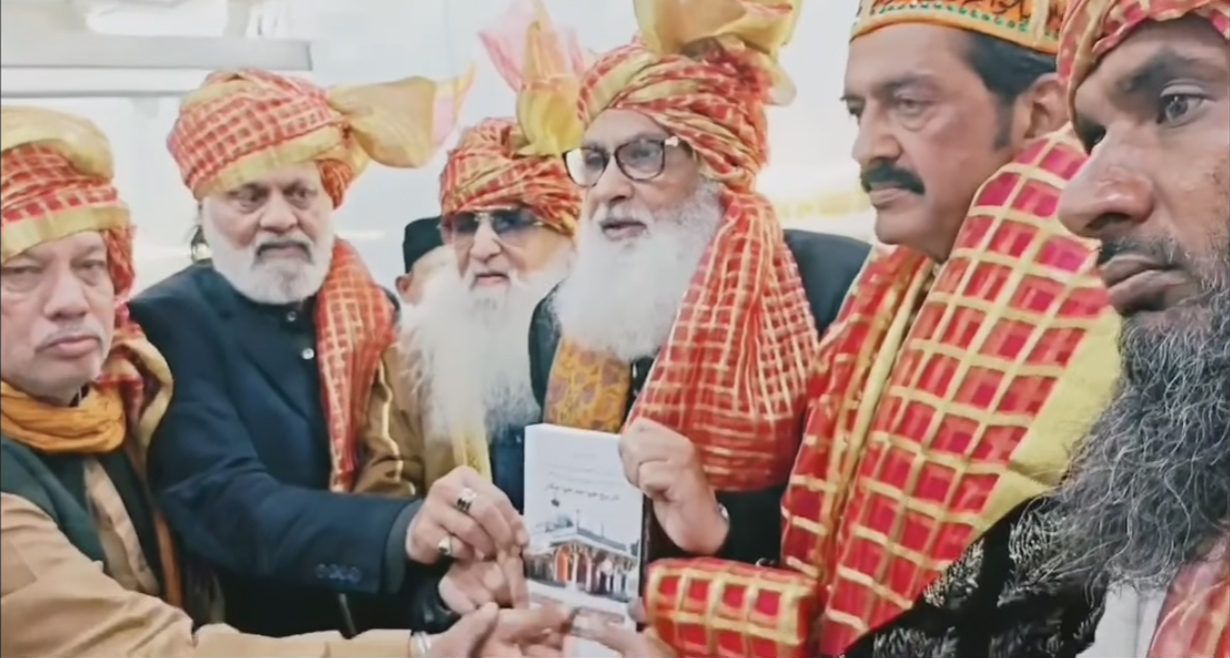
The Anjuman Syed Zadgan Khuddam Khwaja, the official representative body of hereditary Khadims at the Dargah of Hazrat Khwaja Moinuddin Chishti (R.A.), held a press conference at its office within the shrine premises to strongly oppose the Waqf (Amendment) Act 2024, dismiss a lawsuit claiming the existence of a Hindu temple beneath the Dargah, announce the formal migration of a major historical text on Chishti Sufism, and call for unity across Muslim sects and institutions nationwide.
Gaddi Nashin Syed Sarwar Chishti opened the event by reciting verses from Allama Iqbal: “Tadbeerein jo hoke yaqeen paida to kat jati hain janjeerein… Nigah-e-mard-e-momin se badal jati hain taqdeerein.” He quoted further lines emphasizing that worldly power, knowledge, and dominion are mere interpretations of a single point of faith, and that true vision is rare while desire secretly builds images in hearts. Chishti stated that the strongest practice in Islam, as taught by the Prophet Muhammad (PBUH), is love for the sake of Allah. He praised his own efforts in this regard and prayed that Allah reward them and remove distances through divine grace, adding that effort is man’s duty while completion belongs to Allah. He announced plans to work with Syed Sarwar Chishti to foster unity in khanqahs across India and throughout the Muslim community, declaring all followers of the Kalima as brothers.
Chishti condemned the Waqf (Amendment) Act 2024, particularly Amendment Clause 44, which allows non-Muslims and district collectors to be included in Waqf boards. He described this as direct interference in Sharia personal matters and asked rhetorically whether non-Hindus could be appointed under the Hindu Endowment Act, non-Sikhs in Gurdwara management, or non-Christians in Christian missionary schools. Over the past decade, he said, an anti-Muslim ecosystem has been created through concepts like love jihad, UPSC jihad, and land jihad, diverting attention from unemployment and inflation. He criticized government ordinances and acts targeting Muslims, stating that true Muslims must oppose injustice regardless of the perpetrator. Referencing Hussainiyat, he said standing against falsehood is obligatory. The Khadims, as custodians of Khwaja Moinuddin Chishti’s legacy—who brought Islam to India—oppose all anti-Muslim measures and announce their stance from the shrine’s threshold.
YouTube Video
https://youtu.be/bn1AqtPwiWk?si=xfvowE7ya41zx9yv
Chishti recalled protests against the NRC, where Muslims alone faced police batons and bullets on the streets, while secular Hindus shared stages but not the frontline. He urged the community to build excellent schools, colleges, and hospitals, remain united, avoid division over differences, and achieve excellence collectively. When asked how to oppose the Waqf bill, he replied that legal challenges must be filed, but ultimately people must take to the streets, as roads belong to the public while Parliament belongs to the government.
Addressing the lawsuit filed by Vishnu Gupta of Hindu Sena claiming a Mahadev temple under the Dargah, Chishti called it part of a ten-year pattern of searching for temples beneath mosques, even in Mecca. He dismissed claims based on books like Major Karna Lok’s about the Taj Mahal and said billions of poor Hindus, Muslims, Sikhs, and Christians would never allow such division. The court has not yet heard the Section 110 application; the opposing party seeks time and has no evidence. The Dargah’s 800-year heritage is recognized in the Prime Minister’s protocol and by leaders of all parties.
Chishti presented extensive documentation proving the Khadims’ hereditary rights:
– National Archives of India (1972) acknowledging a multifarious collection of royal farmans and sanads.
– District Collector records from Ajmer stamped with confirmation that the Khadims are Qaum Syed Gaut Kazmi, descendants of Hazrat Imam Musa Kazem (A.S.) through Imam Hussain (A.S.), thus Bani Fatimi.
– Bikaner State Archives verifying the same lineage and land grants.
– Mughal imperial farmans with original seals granting six villages as nazrana.
– Supreme Court, Privy Council, High Court, and Sessions Court judgments affirming that the Khadims’ connection is not only ancient but intimate, and that they perform all rituals, including those at the shrine.
On January 22, 2025 (6th Rajab), the Anjuman conducted the “Hijra” of the book *Tarikh Khwaja Khwajgan* by Professor Shamsher Tehrani, who knew 14 languages and referenced 550 sources. The text details which ulema arrived when, offerings by emperors, and farmans from Mughal and contemporary rulers. A sample copy was displayed; full printing with Hindi and English translations will be completed within a month.
Speakers addressed the decline of dargahs and khanqahs as centers of learning after 1857, leading to a gap filled by madrasas and sectarian schools of thought like Deobandi and Barelvi. They described this as “religious malnutrition” in the community, blaming the Khadims’ own failure to continue selling “milk” (knowledge), allowing others to provide adulterated versions. This occurred under conspiracies involving the British and some Muslims.
Chishti recalled the 2007 Dargah bomb blast, stating he filed the first FIR in India identifying Hindu terrorists as perpetrators, long before it was conceivable. He praised ATS chief Hemant Karkare and the agency’s work until 2014, after which investigations changed. He presented charge sheets linking Swami Aseemanand’s Abhinav Bharat and Pragya Singh’s Vande Mataram party to blasts in Malegaon and Ajmer. Terrorism, he said, has no religion—both Hindu and Muslim extremists have attacked the shrine.
He criticized silence among ulema, mashaikh, and Muslim intellectuals in high positions who fear speaking out while in service but voice concerns after retirement. Muslim political leaders, he said, often fail to listen to their community, unlike Hindu counterparts. He urged voters not to sell votes cheaply and to excel in every field, noting Muslims’ deep stake in India even after death.
Chishti expressed regret over the arrest of Mufti Salman Azhari, demolitions of madrasas and graveyards in Mehrauli without notice, and the seizure of a 600-year-old dargah in Baghpat. He supported Maulana Tauqeer Raza Khan’s planned surrender in Bareilly. Sectarian labeling was condemned: claiming Syed status requires accepting certain ideologies, or one is called Rafzi, gumrah, or fasiq.
The conference ended with applause and chants, reinforcing the Dargah’s role in promoting Ganga-Jamuni tehzeeb, communal harmony, and India’s diverse culture while defending Islamic legacy and constitutional rights.