
By T.M. Awan
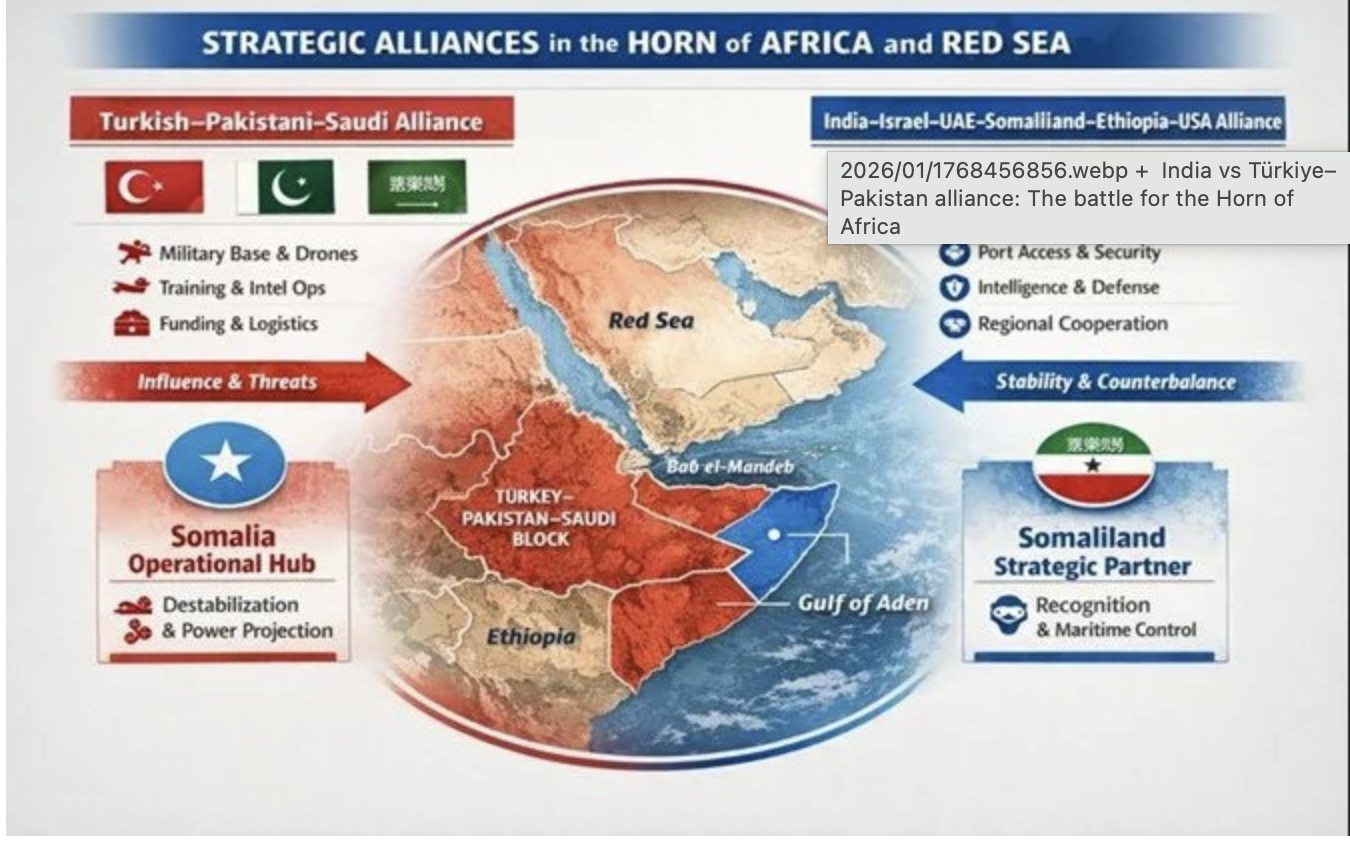
The Middle East, the Red Sea, and the Horn of Africa are rapidly evolving into one of the most sensitive theatres of contemporary geopolitics. What was once viewed largely through the lens of regional disputes is now increasingly being interpreted as part of a wider global contest involving trade routes, energy security, maritime dominance, and shifting balances of power.
At the centre of this transformation lies the Red Sea, one of the world’s most critical maritime corridors. It connects Asia, Europe, and Africa through a narrow but vital passage where a significant portion of global trade flows daily. The Bab el-Mandeb Strait, in particular, functions as a strategic chokepoint whose stability directly influences global supply chains and energy markets. In such a context, even limited instability in these waters carries consequences far beyond the region itself.
Over the past years, the combination of conflict in Yemen, repeated disruptions to commercial shipping, rising naval activity by external powers, and growing securitization of sea lanes has turned the Red Sea into a zone of sustained strategic competition rather than simple maritime passage. What is unfolding is not merely a localised security challenge but a layered geopolitical struggle with global implications.
Within this broader environment, Somalia and Somaliland have once again gained strategic relevance. Somalia continues to grapple with long-standing internal instability, while Somaliland’s contested political status and claims of autonomy have drawn renewed external attention. Much of this interest is linked not only to political considerations but also to geography, particularly its coastline and its proximity to key maritime routes linking the Red Sea with the Indian Ocean.
The port of Berbera has therefore emerged as a focal point in this evolving strategic map. Its location offers direct access to critical sea lanes, making it an attractive point of interest for regional and international actors seeking influence in the Horn of Africa. As competition over maritime infrastructure intensifies, the geopolitical value of such locations continues to increase.
Amid these shifting dynamics, a notable diplomatic trend has been developing between Pakistan, Saudi Arabia, Türkiye, and Egypt. What began as periodic high-level engagement is now gradually taking shape as a more structured consultative process. This evolving interaction reflects a shared recognition among these states that regional challenges in the Red Sea and adjacent areas require coordinated responses rooted in diplomacy rather than escalation.
A key milestone in this process was the meeting held on 17 April 2026 in Antalya on the sidelines of the Antalya Diplomacy Forum. The foreign ministers of Pakistan, Saudi Arabia, Türkiye, and Egypt convened for their third high-level meeting to review regional developments and explore avenues for deeper cooperation.
The meeting was attended by Pakistan’s Deputy Prime Minister and Foreign Minister Ishaq Dar, Saudi Foreign Minister Prince Faisal bin Farhan, Turkish Foreign Minister Hakan Fidan, and Egyptian Foreign Minister Badr Abdelatty. Discussions focused on expanding cooperation in areas of mutual interest, strengthening diplomatic coordination, and reinforcing the role of dialogue in maintaining regional stability.
This meeting followed earlier engagements held in Saudi Arabia and Islamabad, indicating that the process is not isolated or symbolic, but rather part of an emerging pattern of sustained diplomatic interaction. The frequency and continuity of these meetings suggest an effort to institutionalize dialogue on shared regional concerns.
While no formal designation has been assigned to this grouping, analysts have increasingly referred to it as an **Emerging Four-Nation Consultative Framework**. The significance of this development lies not in nomenclature but in its potential strategic weight. Each of the four countries brings distinct geopolitical assets to the table. Egypt holds strategic control over the Suez Canal, one of the world’s most important maritime gateways. Saudi Arabia occupies a central position along the Red Sea coastline and plays a pivotal role in global energy markets. Türkiye continues to expand its diplomatic and security footprint across the Horn of Africa and the broader Middle East. Pakistan, meanwhile, brings strategic depth, military capability, and an increasingly active diplomatic role in regional conflict mediation.
Taken together, these factors suggest the gradual formation of a coordinated regional platform capable of influencing security and diplomatic outcomes across multiple interconnected theatres, including the Red Sea, the Horn of Africa, and parts of the broader Middle East.
The discussions in Antalya also reflected growing concern over maritime security in the Red Sea. Attacks on commercial vessels, disruptions to shipping routes, and rising risks to freedom of navigation were key points of emphasis. The participating countries reiterated the importance of safeguarding international sea lanes and avoiding further escalation that could destabilize global trade flows.
At a broader level, these developments also reflect a subtle shift in regional agency. Rather than relying solely on external powers for security guarantees, there appears to be a growing inclination among regional states to shape their own diplomatic and security frameworks. In this sense, the evolving cooperation among Pakistan, Saudi Arabia, Türkiye, and Egypt represents a gradual move towards regional ownership of key strategic issues.
Pakistan’s role in this evolving landscape is particularly notable. Its engagement in broader diplomatic initiatives, including efforts related to Iran–US dialogue and regional stabilization, reflects an expanding foreign policy footprint that extends beyond South Asia. This positioning reinforces Islamabad’s emerging role as a facilitator in complex geopolitical environments.
In conclusion, the Red Sea is no longer just a maritime trade route. It has become a strategic arena where global and regional interests intersect, often in complex and competing ways. The emerging consultative framework among Pakistan, Saudi Arabia, Türkiye, and Egypt signals an attempt to introduce stability into this volatile environment through coordinated diplomacy.
Whether this evolving structure develops into a more formal mechanism or remains an informal consultative arrangement, its emergence reflects a clear shift in regional thinking. Stability in the Red Sea and surrounding regions is increasingly being viewed not as an external responsibility, but as a shared regional imperative.
(The writer is a Journalist, Strategic Communication, and Public Diplomacy Advisor based in Islamabad. Email: Hasilekalaam@gmail.com)