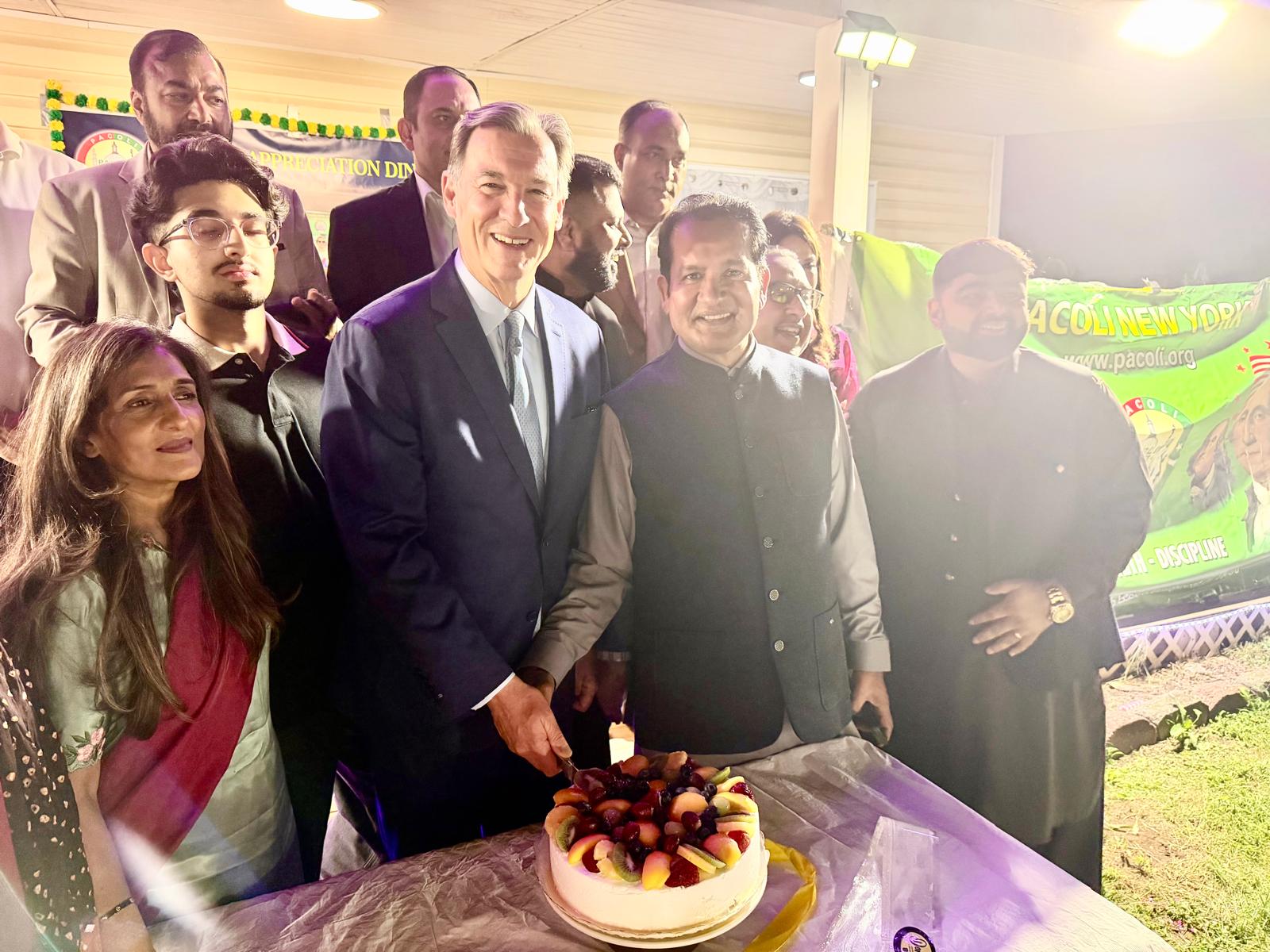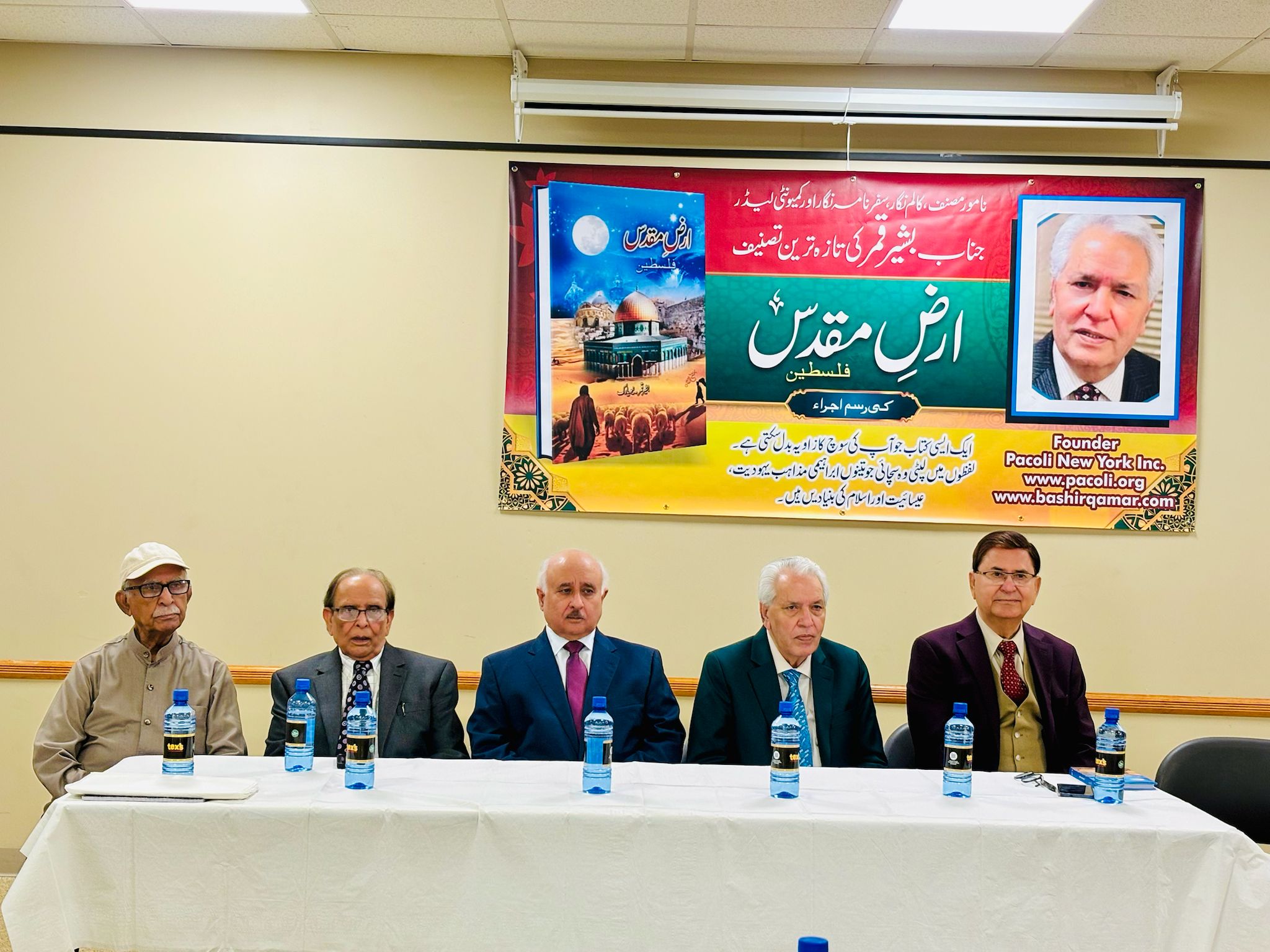
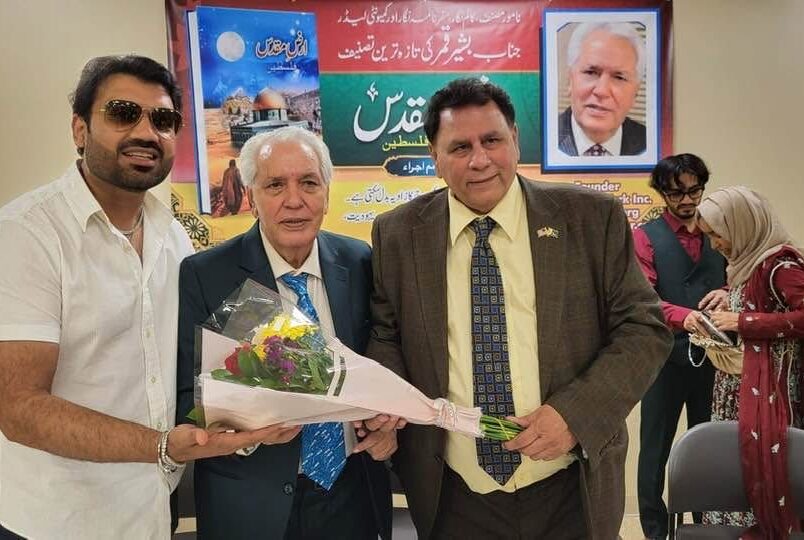
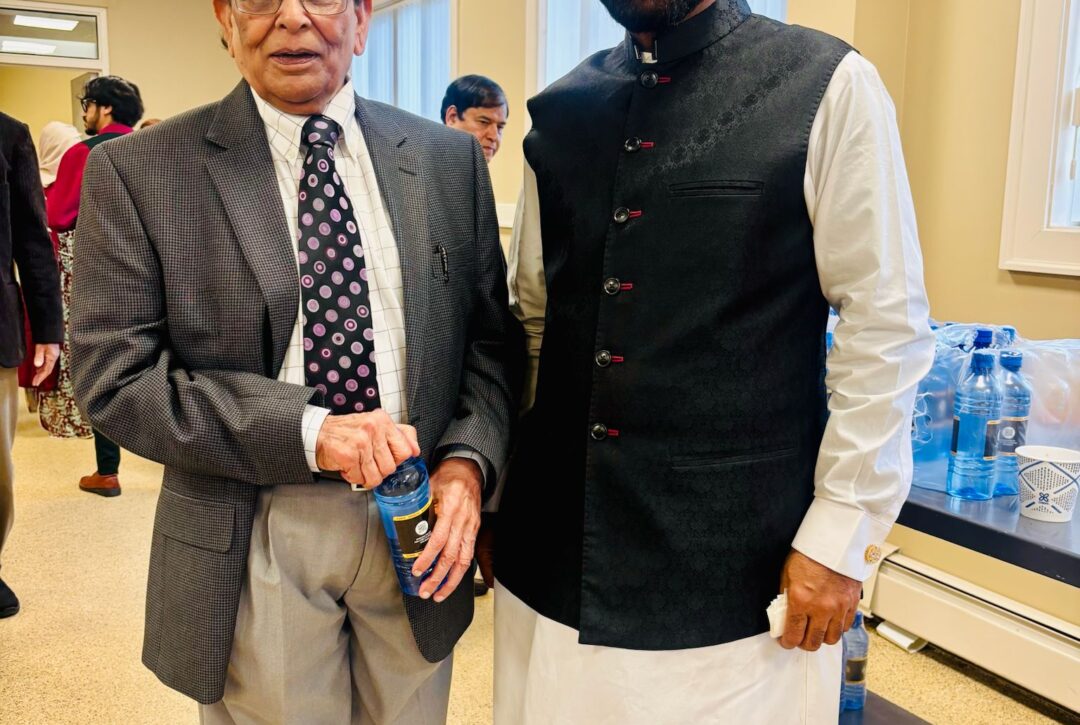
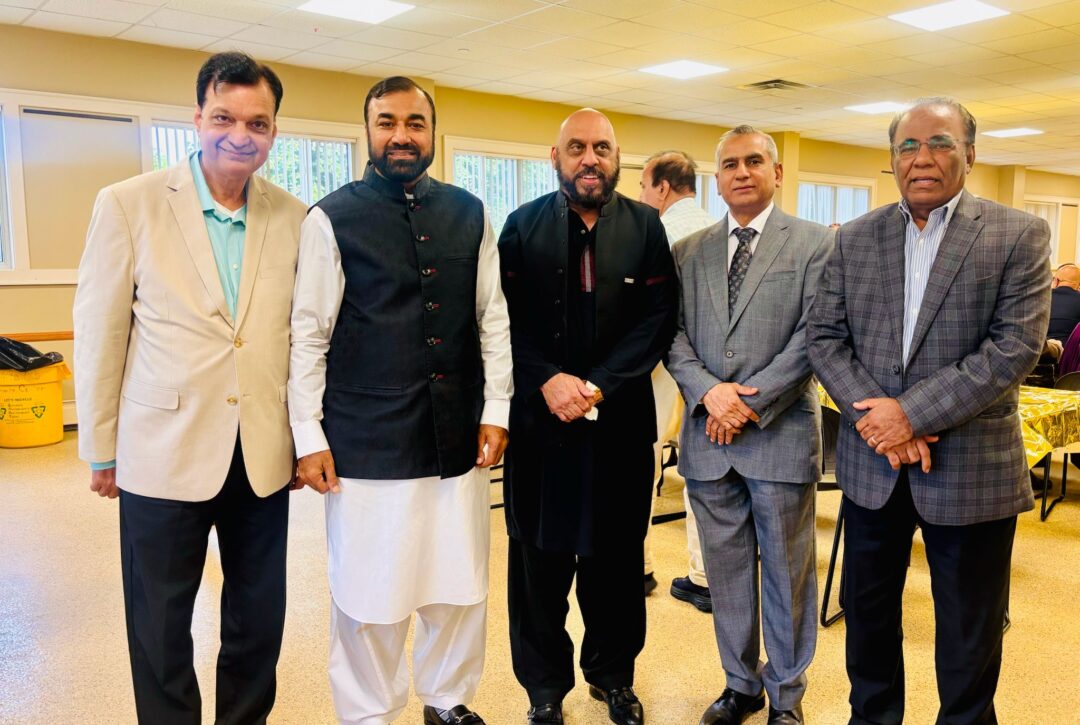
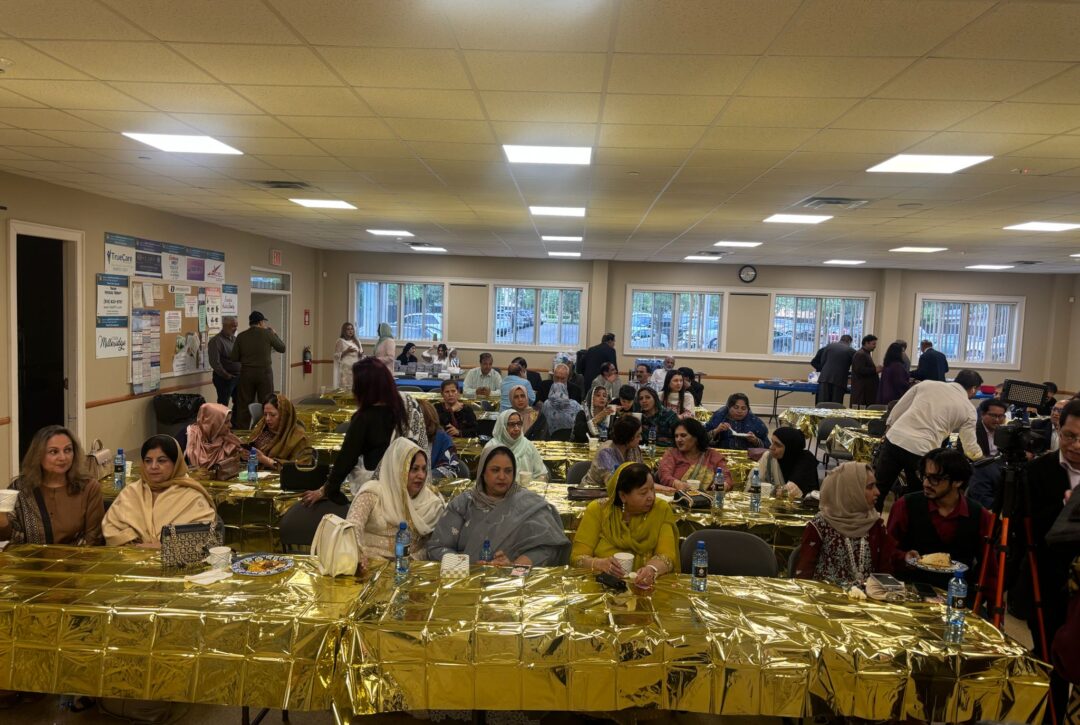
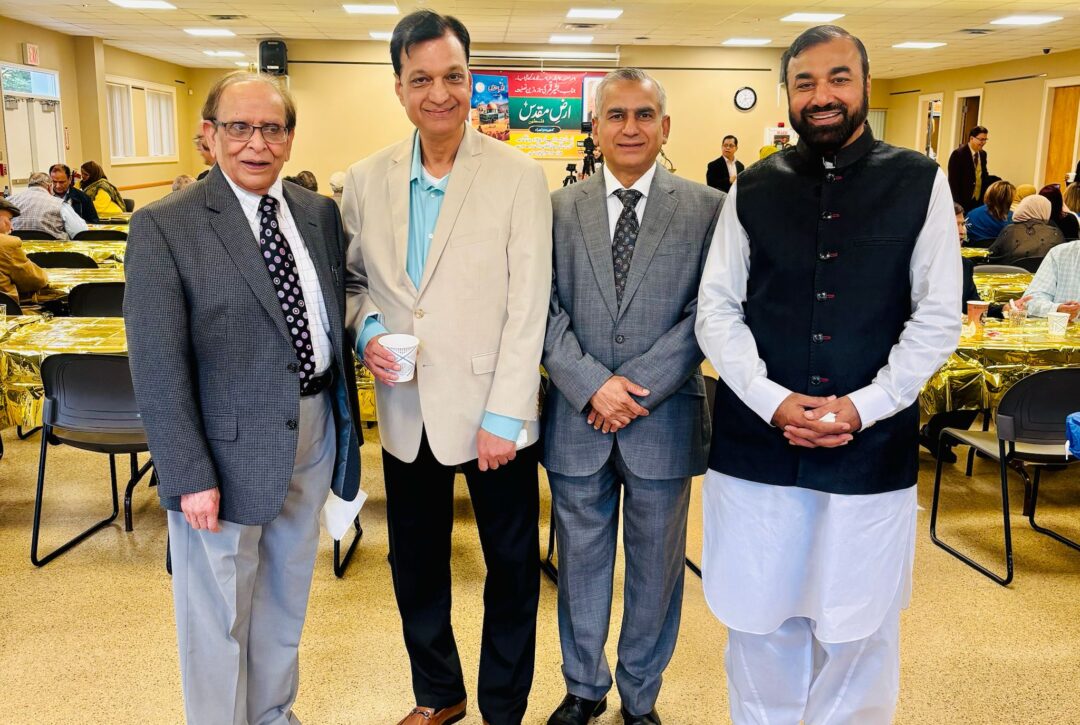
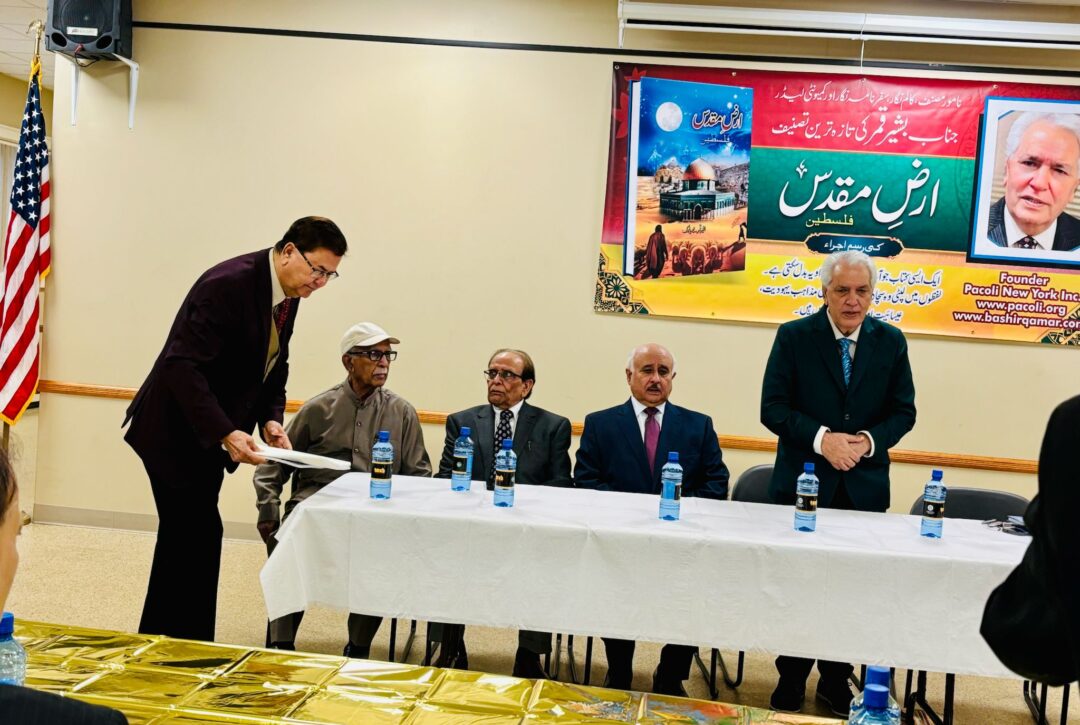
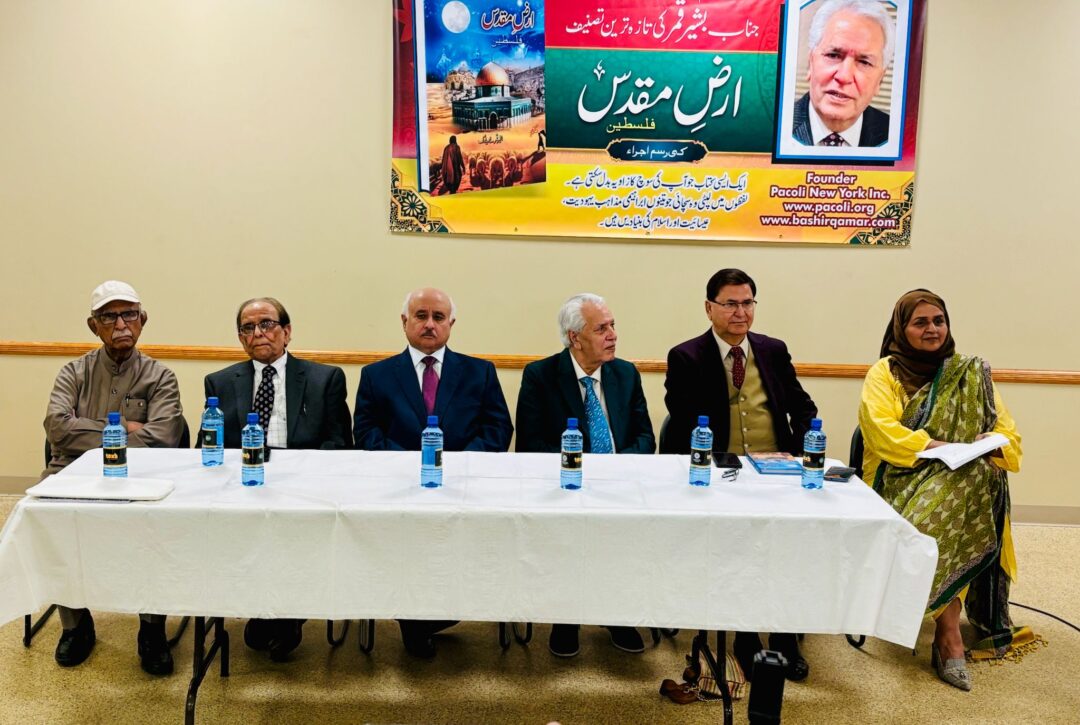
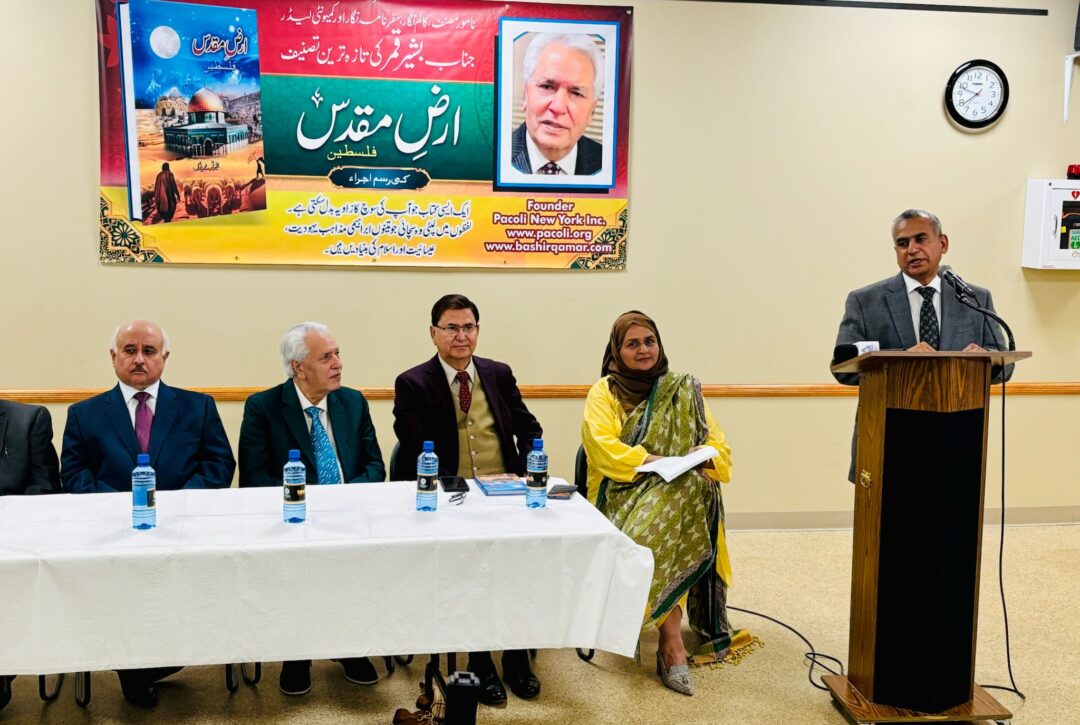
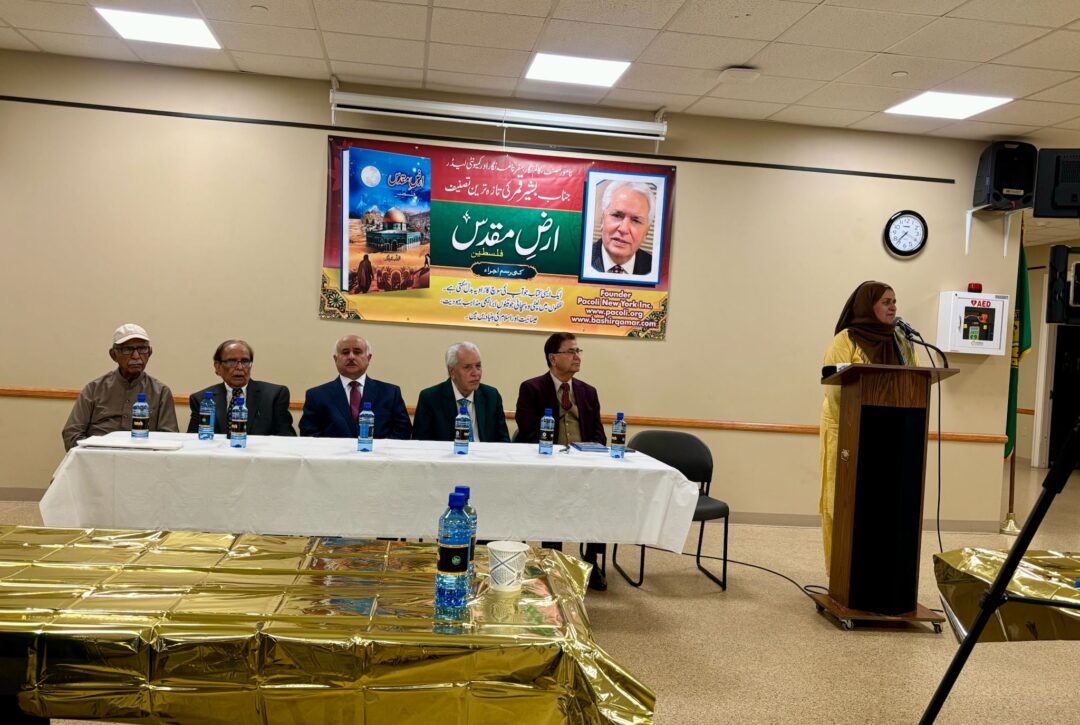
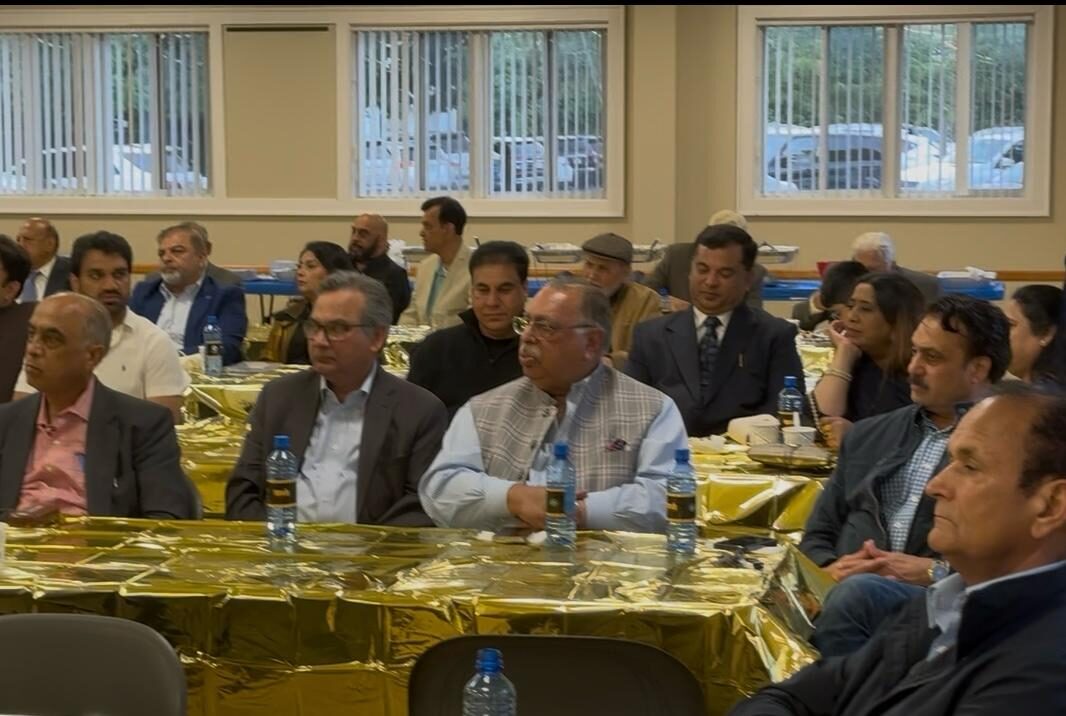
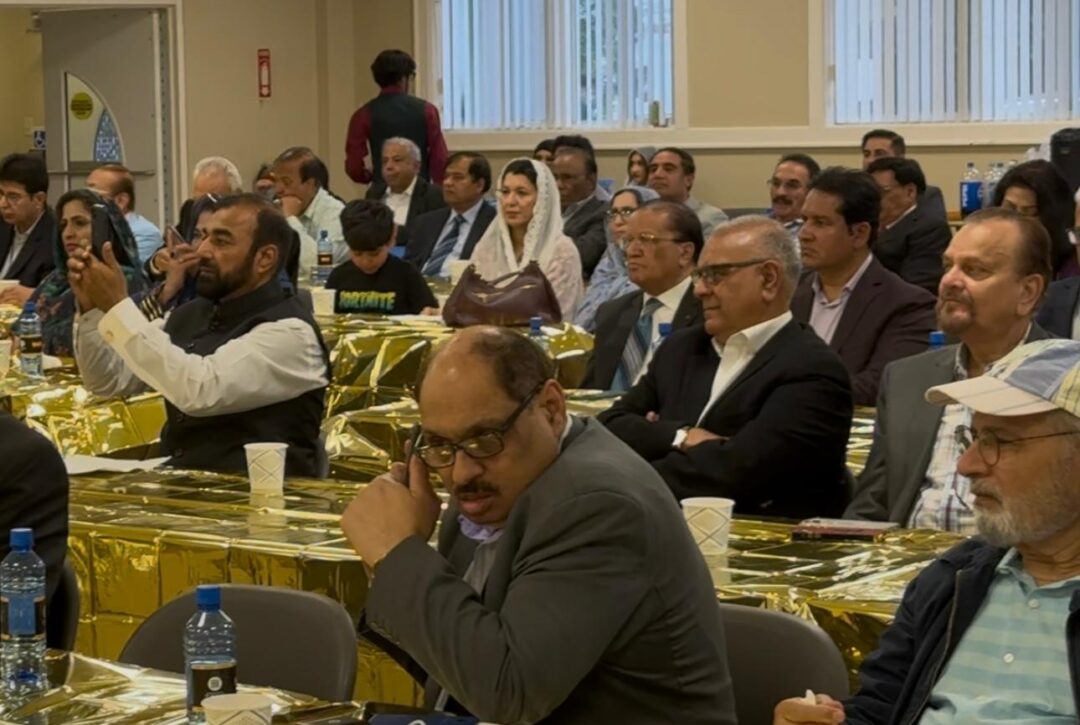
New York: By- Farooq Mirza— Bashir Qamar’s new book, Arz-e- Moqadas (The Holy Land of Palestine)was launched in New York, USA. A large number of prominent individuals from various walks of life, including journalists, scholars, poets ,opinion makers and community women attended the Event.The launching Ceremony of Bashir Qamar ‘s Book Arz-e- Maqadas was the one of the great literary Event in New York and fist time people learned about the sacred land , its historical and strategic importance .
Bashir Qamar unearthed many hidden facts and raised many questions . His wife Bagam Tasneem was the Queen of the Ceremony and she made passionate speech about his Book and her life time living experience with Bashir Qamar .
While addressing the attendees, the author, Bashir Qamar, stated:
“I am a devout Muslim, but I cannot ignore historical facts. I recently visited Palestine as well as India. During my travels, I closely observed the conditions in both countries and have written this book without any bias. Every word in this book is rooted in truth.”
In the preface of the book, three distinguished personalities have shared their thoughts on the work, and their names are mentioned in order of appearance.
Wasif Hussain Wasif wrote beautiful review and said I met a handsome young man: Bashir Qamar. Graceful in appearance, well-dressed, articulate, and confident—his presence was always felt.
Bashir Qamar possesses the rare ability to make his presence known in any setting. Though we had our own perspectives and ways of thinking and rarely engaged in direct dialogue, familiarity found its own path, and our journey together continued.
Bashir Qamar is a straightforward person—there is no complexity in understanding him. I’ve known him for years, and a single year is often enough to understand someone. He was both a publisher and a columnist—and a columnist cannot hide himself. Bashir Qamar was no exception.



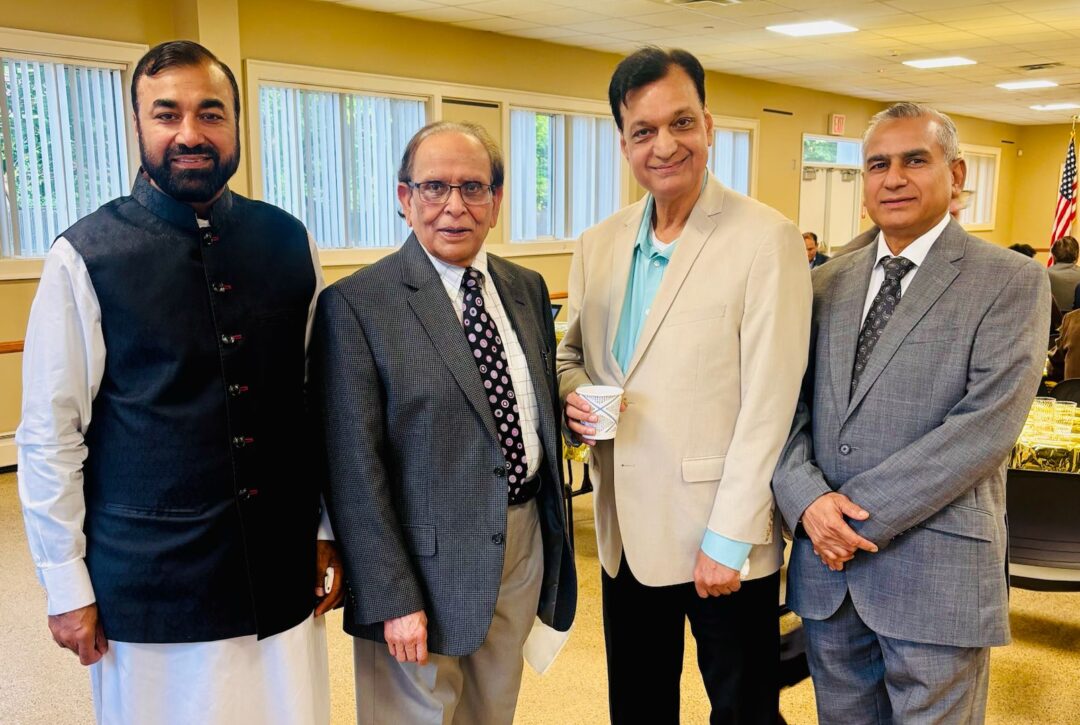


A sharp intellect and a man conscious of time, he has lived a fulfilling life in this city. He has explored all corners of thought and has been a friend to the camera and microphone. He can speak extempore in any gathering without the slightest hesitation.
Mastering the art of oratory, he tries to pour onto the page everything stored in some compartment of his mind.
Despite illness, Bashir Qamar has gifted his readers three books within just two years. His latest manuscript, “Manshoora”, is about the land of Palestine.
Palestine—the land of the Prophets—is steeped in sacred stories. The region’s history carries immense significance. When Palestine is mentioned, reverence awakens, Durood is naturally recited, and eyes well up with emotion.
One can read Bashir Qamar’s soul in his words. His book also includes an account of his journey to India, where his focus remained largely on mosques, shrines, and historical places. With the same reverence, his gaze lingered in the land of Palestine.
Bashir Qamar visited Palestine approximately three times.
A restlessness compelled him to return again and again. I cannot say exactly how much time he spent there, but I can estimate that he wandered its streets deeply and purposefully. I cannot speak for the condition of his heart, but after reading the manuscript, it becomes clear that he was searching for something.
At times, while reading, it feels as though Bashir Qamar is a native of Palestine, calling to the reader: “Come! Let me show you my homeland.” In this call, he pours out his hidden affection. He describes Palestine’s streets with such love that the reader feels as though they’ve walked through them—living the experience through Bashir Qamar’s prose.
This literary charm is present throughout—silken threads of short, simple sentences interwoven with emotion. There’s a magical fluency to his storytelling, like a river in motion. When one hears the name “Palestine,” all those stories from the Quran, Psalms, and Gospels, as well as the Tazkirat al-Anbiya and Qasas al-Anbiya, rush to mind. Their fragrance lingers in the land of Palestine.
But Bashir Qamar also shares things that could only be discovered through deep research—information that lies beyond the reach of the average reader. For example, he offers a detailed account of Zedekiah’s Cave—something new even to me. He also discusses, without bias, the Church of the Rock, the Church of Mary Magdalene, and the Church of All Nations. Not once does he write negatively about Jews or Christians, not even indirectly.
His chapter on the Dead Sea stands out, as do his discussions of the Masada Fortress and Al-Khalil (Hebron). These places are not commonly known, yet the author brings them to life. In these moments, Bashir Qamar’s pen becomes that of a tourist. When I asked him about this, he replied that everything remained in his memory and flowed directly to the page. That surprised me.
There are many dimensions to Bashir Qamar’s life. But a transformation in his thoughts and heart can be seen in his writing—especially in Qamar ki Guftagu and Arz-e-Filasteen. There is modesty in his prose. I cannot say whether this modesty comes from the holiness of the land or from the overflowing of Bashir Qamar’s heart.
Arz-e-Filasteen is a beautiful document that will appeal both to the emotional soul and the observant eye. This book unveils another layer of Bashir Qamar’s persona, which will help readers better understand the man behind the words.
Congratulations to Bashir Qamar on the publication of this remarkable book!
The renowned scholar
Professor Dr. Maqsood Jafari also made note on
“Holy Land of Palestine”
He said Mr. Bashir Qamar has been living in New York for a long time. He is regarded as a crown among Pakistanis admired by both the elite and the common people. He is unparalleled in his journalistic and social services, and at heart, he is a spiritual servant. His personality is graceful and humble.
A few years ago, when I was residing in New York, he used to publish a weekly newspaper in both Urdu and English, in which my English articles were regularly featured. His wife,Bagam Tasneem Sahiba, is also renowned for her unmatched contributions to social service—truly reaching the heights of excellence.
Even at this age, they are two forms of one soul. As Mirza Ghalib beautifully said, “Loyalty is true faith, provided it is steadfast.”
“If you die in an idol house, then you are a Brahmin in the Kaaba.”
But neither of them are Brahmins—they are believers, lovers of the Prophet (PBUH). Their spiritual and religious devotion is beyond doubt or speculation. As Allama Iqbal said:
“If you are loyal to Muhammad, then we are yours.
What is this world? Yours are the Tablet and the Pen.”
Mr. Bashir Qamar recently sent me his travelogue titled “The Holy Land of Palestine” and sought my opinion. Generally, Muslims go for pilgrimage to the Kaaba and the Prophet’s shrine, as well as to visit the Ahlul Bayt and companions of the Prophet (PBUH). However, Muslims tend to avoid visiting Israel for several reasons. Due to the longstanding Israeli oppression of Palestine, it is neither safe nor easy for Muslim pilgrims or tourists to go there.
In the travelogue, Bashir Qamar recounts: “When I got into a taxi and the Jewish driver found out that we are originally from Pakistan but now live in America, he said that Pakistanis are staunchly against the existence of Israel.” This statement reflects the tense atmosphere that surrounds the region. According to his writing, the people of Palestine live under constant hardship. The American passports of Bashir Qamar and his wife served as their only shield—though even that barely softens Israeli attitudes.
The travelogue is written in a simple and straightforward language. It is both fascinating and informative—an extraordinary combination. Palestine is considered the Holy Land because it is the land of the Prophets. The establishment of Israel in Palestine was a British conspiracy against Muslims. The term “Israel” refers to Prophet Jacob, and the Children of Israel are mentioned numerous times in the Holy Quran.
In addition to the ancestral home of Prophet Abraham (Ibrahim), Palestine also holds the resting places of his sons: Prophet Isaac (Ishaq), Prophet Jacob (Yaqub), and Prophet Joseph (Yusuf). The grave of Prophet Moses (Musa) is also located in Palestine. However, while the grave of Prophet Joseph lies in the Israeli-occupied zone where Muslims are not allowed, the grave of Prophet Moses is in the Muslim-controlled area, which Jews are free to visit.
Bashir Qamar writes that during his visit to the grave of Prophet Musa, he found it in a desolate area with only two or three visitors. Jews rarely visit it—their main focus remains the Wailing Wall. This travelogue is deeply educational. It not only addresses the historical, social, and religious aspects of Palestine and Israel but also explores their economic and political dynamics. Bashir Qamar’s commentary reflects a deep awareness of Islamic history and ideology.
Alas, Western colonialism has not only divided Palestine but has also wounded the hearts of Muslims. The hostility toward Islam has crossed all limits. Zionism’s dream of a “Greater Israel” even includes the sacred cities of Mecca and Medina—yet Muslims remain unaware, lost in illusions.
In Palestine, Muslims, Jews, and Christians coexist. There is no logical justification for establishing an exclusively Jewish state. In my English essay collection The Testament of Truth, I’ve written an article titled “Democratic Palestine”, where I argue that followers of all three religions should have the right to government representation based on votes. Lebanon has a joint government of Christians and Muslims. A similar model could be the only viable solution for Palestine.
Israel has blatantly disregarded UN resolutions and has continued to massacre Muslims for over seventy years. What’s happening in Gaza over the past year—the brutality inflicted on Muslims—is a stark slap in the face of those who claim to champion peace and human rights.
I wholeheartedly applaud and congratulate Bashir Qamar Sahib for his dedication. He has written such an insightful and captivating book through immense effort. I pray that he continues his journeys across the globe and that his friends and readers continue to benefit from his enlightening work. May this prayer reach the heavens. Ameen.
Another scholar Ateeque Siddiqui who was also the Guest of Honor in launching ceremony of the Book and he also wrote great review about Book . He said that Bashir Qamar Sahib’s new work, Ardz Muqaddas: Palestine, stands out for its simplicity of narration, its rich blend of religious and historical references, and the thought-provoking questions it raises—questions that require deep reflection. Beyond its many literary merits, one of the most remarkable features of this book is that its essence lies not on the surface, but beneath it.
To truly grasp its message, the reader must approach the historical truths with a wide lens—one that the author himself has used to observe from above the cultural chaos of the modern era. He does not pretend to sculpt a picturesque narrative at the dawn of a new age; rather, he invites us to see the truth—unfiltered by the stained lenses of prejudice.
The most prominent and central chapters of the book include discussions on the Church of the Holy Sepulchre, Bethlehem, the Dead Sea, the Wailing Wall, the Dome of the Rock, and the Church of the Nativity. In the fifth chapter, the author writes while describing the significance of the Wailing Wall:
“Muslims believe that this is the place where the Prophet Muhammad (peace be upon him) ascended to the heavens during the Mi’raj. Christians believe this is where Jesus was crucified. Jews claim that it is the site where Abraham offered the sacrifice of Isaac.”
Through this multidimensional narrative, Bashir Qamar presents a layered perspective—one that does not dictate conclusions but rather encourages readers to engage, explore, and interpret these sacred intersections of faith and history for themselves.