The United States National Security Strategy (NSS) is Washington’s most consequential strategic document, issued directly by the White House to define how America views global threats, prioritizes regions, and deploys its political, military, economic, and diplomatic power. Unlike speeches or campaign statements, the NSS is not written for public consumption; it is a governing blueprint for execution across the US national security apparatus.
The NSS 2025, recently released by the Trump administration, is a relatively short document, yet its implications are extensive. It outlines which relationships will be strengthened, which recalibrated, and where ideology gives way to hard strategic realism. Crucially, by the time such a strategy becomes public, many of its decisions are already unfolding. Global events that appear sudden or disconnected often turn out to be the operational chapters of this very document.
Seen through this lens, developments that have recently dominated international headlines—from renewed engagement with Pakistan to America’s revived interest in Greenland and Venezuela—no longer appear random. They are interconnected expressions of a single strategic logic now formalized in NSS 2025.
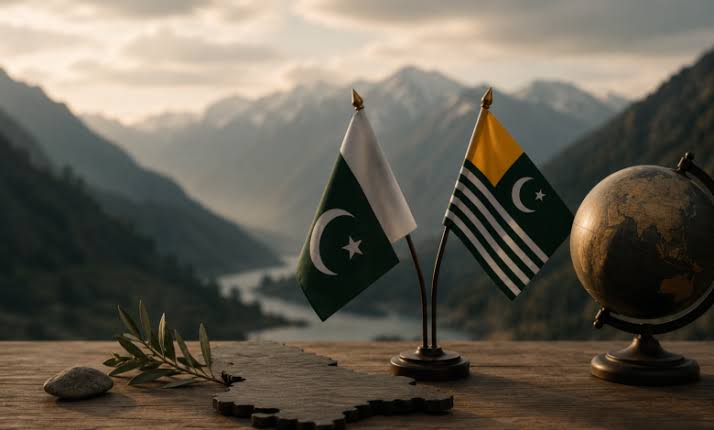
Pakistan’s re-emergence in international discourse is a telling example. Over the past months, Western media has adopted a noticeably different tone toward Islamabad. The clearest signal came with Washington’s approval of a long-delayed $636 million support and upgrade package for Pakistan’s F-16 fleet, widely covered by Reuters, Bloomberg, and The Washington Post. This decision is not merely about aircraft; military cooperation is among the most explicit forms of political signaling in international relations.
Commentary in leading US outlets underscores this shift. Analysts have openly described it as a recalibration of Washington’s South Asia policy, suggesting that Pakistan has re-entered America’s strategic frame not out of sentiment, but necessity. The emphasis is telling: Pakistan is no longer viewed through a purely ideological or democratic lens, but as a functional state actor within a larger geopolitical design.
This marks an important distinction. The NSS 2025 makes clear that the United States will prioritize core interests over values, and engagement will be selective, transactional, and interest-driven. Democracy promotion, human rights rhetoric, and normative language are notably subdued. What matters instead is geography, access, and utility.
Pakistan fits into this logic for three reasons. First, geography: Pakistan sits at the intersection of South Asia, Afghanistan, the western flank of China, and the Gulf security architecture. Second, security relevance: counterterrorism intelligence, regional monitoring, and crisis management remain difficult for Washington without Pakistani cooperation. Third, signaling: the F-16 decision communicates to India—and the wider region—that US policy is not one-dimensional.
This does not imply a romantic reset or strategic partnership in the traditional sense. It reflects an instrumental engagement, driven by American calculations rather than Pakistani preferences. Washington’s message is implicit but clear: internal political arrangements in Pakistan are secondary so long as broader strategic objectives are served.
India, meanwhile, retains its position as a central pillar of US Indo-Pacific strategy. NSS 2025 continues the Biden-era framing of India as a regional security contributor and counterweight to China, reinforced through mechanisms such as the Quad. This permissive posture has historically emboldened New Delhi, often at the expense of regional stability. What changes under NSS 2025 is not India’s importance, but the reintroduction of balance—however limited—through renewed engagement with Pakistan.
This balancing logic becomes clearer when viewed globally. America’s renewed attention to Greenland, for instance, has little to do with symbolism and everything to do with geography and future competition. Greenland sits astride emerging Arctic shipping routes and resource zones critical to future trade, energy, and defense supply chains. As Arctic ice melts, new sea lanes and mineral access points are opening—areas where China has already signaled interest by calling itself a “near-Arctic state.” The US response is preemptive containment.
Similarly, Venezuela’s sudden return to Washington’s strategic focus is not about ideology or governance. It is about denying China and Russia leverage in America’s immediate neighborhood. NSS 2025 explicitly states that the United States will reassert influence in the Western Hemisphere, signaling a pushback against external powers in what Washington still views as its strategic backyard.
Across regions, the unifying thread is unmistakable: China is the primary driver of US strategic behavior. Whether it is South Asia, the Arctic, Latin America, or maritime trade routes, American actions are increasingly shaped by competition with Beijing. NSS 2025 formalizes this reality without rhetorical excess.
The Middle East, by contrast, is framed as a region to be managed and insulated rather than transformed. Gaza is acknowledged as a trigger for instability, yet Palestinian statehood and humanitarian resolution are conspicuously absent. Iran is addressed through deterrence and containment, with regime change deliberately left ambiguous. Afghanistan is described in terms of risk insulation and counterterrorism, not re-engagement—once again highlighting Pakistan’s relevance as a facilitating actor rather than a frontline battleground.
Taken together, NSS 2025 offers a sobering clarity. It is not a document of ideals but of priorities. It does not promise order, only advantage. For Pakistan, it presents both an opening and a warning: relevance has returned, but only on transactional terms. For India, it reinforces strategic elevation while subtly reminding New Delhi that regional dominance still operates within American calculations.
Above all, NSS 2025 confirms a simple truth of international politics: power moves first, explanation follows later. What many interpret as unpredictability is often long-planned execution. The strategy was already in motion before it was published. Now that it is public, the world is merely catching up.
*About Author:* The writer is a career journalist, Strategic Communication & narrative Specialist and IR Scholar based in Islamabad. Email s Hasilekalaam@gmail.com