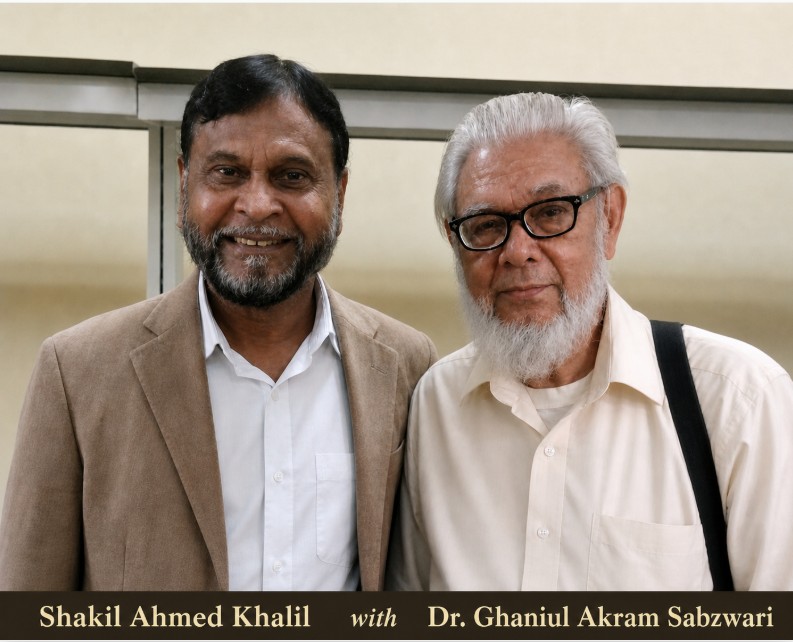
By: Shakeel Ahmad Khalil, Karachi
In the world of knowledge and enlightenment, teachers are like radiant lamps who are not only illuminated by the light of knowledge themselves but also enlighten the hearts and minds of their students with the same brilliance. In the field of Library and Information Science, one such eminent and dignified personality is Dr. Ghani-ul-Akram Sabzwari. Through his academic, teaching, and professional services, he not only enriched the Department of Library and Information Science at the University of Karachi but also, later, he played a significant role in the promotion of knowledge by serving for more than three decades at Umm Al-Qura University, Makkah, Saudi Arabia. His life stands as a shining example of struggle, sincerity, love for knowledge, and devotion to books, serving as a guiding light for future generations.
My first meeting with Dr. Sabzwari took place at Hamdard Library through the introduction of Hakim Muhammad Saeed. At that time, books from Hakim Sahib’s personal collection were being transferred to the Hamdard Library, and a team was formed under Dr. Sabzwari’s supervision to organize and arrange them. I was included in this team as a coordinator. Dr. Sabzwari would visit the library daily, and during work, I had the opportunity to interact with him. I am pleased to say that his kind manner and encouragement played a major role in drawing me toward the field of Library and Information Science, although my elder brother, Mazhar Bari Khan, who was already associated with this profession, was also a source of inspiration.
Dr. Sabzwari was born in December 1935 in Muzaffarnagar (British India). After completing his B.A. in 1956, he began his professional career as a Readers’ Advisor at the American Information Center, Karachi. During this period, he earned a diploma in Librarianship from the University of Karachi in 1959. He remained associated with the Center until 1962. Later, on a Fulbright Scholarship, he left his job to pursue higher education in the United States and enrolled at the University of Michigan, where he obtained an M.A. in Library and Information Science in 1964. Upon his return, he joined the Department of Library and Information Science at the University of Karachi as a lecturer, later serving as Assistant Professor and eventually as Head of the Department. In 1975, when he was offered a position of librarian at Umm Al-Qura University, he applied for long-term leave from University of Karachi, which was not granted. Eventually, he relinquished all benefits and moved to Makkah, where he remained until 2002. During this period, he earned his doctoral degree from Century University. While serving at Umm Al-Qura University, he also arranged employment opportunities for ten of his colleagues from the University of Karachi.
In 1965, he established a publishing institution named the “Library Promotion Bureau,” under which more than fifty books were published. He also launched a quarterly journal in Library Science, the Pakistan Library Bulletin (later titled Pakistan Library and Information Science Journal), which continued publication for 55 years. Today, the journal is being published under the administration of the Department of Library and Information Science, University of Karachi. Currently, Dr. Sabzwari resides abroad with his children.
I had the privilege of learning a great deal from Dr. Sabzwari. His personality is a practical embodiment of qualities such as hard work, dedication, and perseverance, essential for success in life. Had I not benefited from his companionship, I might not have understood these qualities so deeply. Through his gentle and compassionate behaviour, he taught that one must remain steadfast in all circumstances. He was always at the forefront in encouraging his students. Supporting a financially struggling student throughout his education, and even helping arrange employment abroad, is a shining example of his generosity and humanity. During my education and later in my professional life, his guidance and mentorship remained a constant source of support. He consistently encouraged me to continue writing and research alongside my professional duties. The articles I published in the Pakistan Library Bulletin are, in fact, a result of his encouragement and guidance.
His attachment to the Pakistan Library Bulletin was extraordinary. His sacrifices for its publication are unparalleled. One notable incident illustrates this: during the early days of the journal, when financial resources were extremely limited, he once paid his entire salary to settle a printing press bill. As a result, he faced severe financial difficulties in managing his household expenses, yet he never allowed the publication of the journal to cease.
Dr. Ghani-ul-Akram Sabzwari is among those fortunate individuals who were blessed with a long stay in the proximity of the Holy Kaaba. After joining Umm Al-Qura University in Makkah, he spent nearly 28 years there. During this time, a room in his house was always reserved for pilgrims performing Umrah and Hajj. He and his family served the guests of Allah with immense love and sincerity, providing accommodation, food, and even taking care of washing and ironing their clothes. This noble practice continued for approximately 28 years.
His affection for his students extends across generations. His connection even with my children reflects the same kindness and care. He belongs to that rare group of teachers who do not merely impart knowledge but shape the personalities of their students and help them become better human beings.
Dr. Ghani-ul-Akram Sabzwari’s personality stands as a shining example in the field of Library and Information Science. His academic, teaching, publishing, and social contributions have strengthened this discipline not only in Pakistan but also internationally. His life is an ideal model for future generations, rooted in knowledge, service, and sincerity.
In conclusion, I would say that Dr. Ghani-ul-Akram Sabzwari is a personality who lived knowledge, spread knowledge, and used it to serve humanity. His life teaches us that knowledge is not confined to books; rather, it lives through character, action, and service. I pray that Allah grants him good health and keeps his presence among us, so that we may continue to benefit from his knowledge and experience.