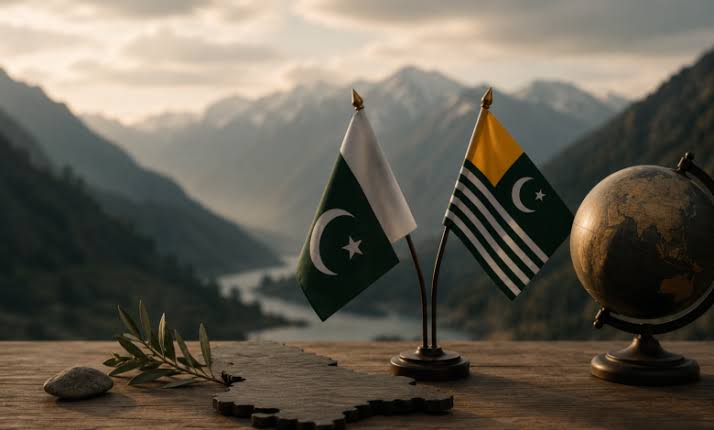
August 5, 2019, marks a dark chapter in the history of Kashmiris—the day India revoked the special constitutional status of occupied Jammu and Kashmir, betraying not only the historical, moral, and legal promises made to the Kashmiri people but also violating international laws, United Nations resolutions, and bilateral agreements. The Day of Exploitation is not merely a day of protest; it is a manifestation of our national dignity, intellectual resistance, and ideological commitment. Today, as the leadership of the freedom movement remains imprisoned in the occupied valley, the media is gagged, and human rights are being trampled, the need for ideological unity, political stability, and national cohesion in Azad Kashmir has become more critical than ever.
Unfortunately, Azad Kashmir, long regarded as the ideological stronghold of the freedom movement, now finds itself embroiled in internal political crises. Economic instability, mistrust, poor governance, and power struggles among political parties have severely damaged public unity. Tribalism, ethnic prejudice, and opportunistic leadership have prioritized personal agendas over state interests, weakening the narrative of the freedom struggle. While public action committees have emerged as a strong voice against inflation, mismanagement, and poor governance in recent years, if their discourse does not align with the freedom movement, forces like India may exploit these movements to target Pakistan and its armed forces. We must acknowledge that while public awareness is essential to resolving issues in Azad Kashmir, becoming a tool for the enemy’s narrative would be disastrous.
Jammu and Kashmir refugees, settled in various cities across Pakistan, have been granted representation in the Azad Kashmir Assembly through twelve reserved seats. This issue has long been a subject of administrative and political debate. In the current circumstances, with limited resources and heightened political tensions, transparency, effective representation, and public trust regarding these seats are urgently needed. Establishing an autonomous commission, conducting a timely census, and addressing refugee issues with dignity within the political mainstream have become indispensable.
As India tightens its illegal grip on occupied Kashmir, it has also intensified efforts to destabilize Azad Kashmir. Cyberattacks, fifth-generation warfare, false narratives, and the financial backing of internal elements are evidence that the enemy is now focused on hollowing out the ideological and political foundations of Azad Kashmir. In this context, *Operation Bunyan Marsous*, initiated by the Pakistan Armed Forces, is not limited to border defense alone—it symbolizes a broader national understanding, intellectual resistance, and unity. This operation, with the cooperation of state institutions, educational circles, civil society, and the media, provides a comprehensive framework for internal stability, which must be expanded further as a pressing necessity.
The Day of Exploitation reminds us that while political differences may exist, no compromise can be made on the national ideology, the Kashmir freedom movement, and our allegiance to Pakistan. We must align public action committees intellectually with the freedom struggle, train students, teachers, lawyers, scholars, and women in educational institutions about conscious resistance and national unity, resolve the issue of refugee seats through consensus, and expand initiatives like *Bunyan Marsous* beyond defense into educational and cultural domains. The media, social media, and public discourse must amplify the narrative of the freedom struggle, Pakistan’s bond with Kashmir, and resistance against Indian oppression.
August 5 is not just a wound for the occupied valley—it is a test of Azad Kashmir’s conscience and national pride. If we set aside our differences and prioritize unity and ideological harmony, all of the enemy’s schemes can be reduced to dust. But if we choose division, negligence, and ideological deviation, our land may become a battleground for enemy propaganda. It is time to transform the Day of Exploitation from a mere day of protest into a new beginning of ideological renewal, collective understanding, and revolutionary unity. *Insha’Allah*, the day is not far when Kashmir will become part of Pakistan.